

Drive Albania's two UNESCO World Heritage cities, the Albanian Riviera and Butrint's Roman ruins in eight days from Tirana on one of Europe's most underrated road trips.
Albania arrived late on the European road-trip circuit and is making up for it quickly. A country that was almost entirely sealed from foreign visitors until 1991 has spent the decades since quietly assembling a case for becoming one of the continent's most rewarding driving destinations: two UNESCO World Heritage cities within 80 km of each other, a coastline that has more in common with pre-development Greece than with anywhere on the Adriatic, and Roman ruins that would draw enormous crowds if they were in Italy. This eight-day loop from Tirana covers the best of southern Albania in a route that is straightforward to drive and genuinely surprising throughout.
Tirana is a better introduction to Albania than it might initially appear. The city was reconstructed almost entirely under communism and has a distinctive Soviet-modernist scale, but the restoration of the Blloku district and the colourful repainting of central buildings during the early 2000s created something worth walking. Skanderbeg Square, with the National History Museum's striking mosaic facade, is the logical starting point; the Blloku neighbourhood (once walled off for Communist Party elite) a short walk south is where to eat.
Plan for Day 1: Arrive and check in. Walk to Skanderbeg Square and the National History Museum. Dinner in Blloku. Book Butrint and Peles Castle tickets online in advance.
The drive south from Tirana to Berat follows the A3 Autostrada and then the SH7 national road through the Muzake plateau: fertile lowland that opens, after two hours, into the Osum valley and the sight of Berat's white Ottoman houses stacked up the hillside above the river. It is one of the most striking arrivals in the region.
Berat has been a UNESCO World Heritage Site since 2008, inscribed for its late medieval urban architecture. The old quarter of Mangalem on the left bank is the main draw: Ottoman houses with their distinctive rows of matching windows (which gave the city its nickname) climbing steeply to the Kalasa, a Byzantine and Ottoman fortress that is still partially inhabited. The Onufri Museum inside the fortress holds the finest collection of Byzantine icons in Albania, the work of a 16th-century master painter whose use of brilliant red pigment (derived from bear's bile) was technically distinctive enough to make his work immediately recognisable.
The second day in Berat works well for the right-bank quarter of Gorica, which is connected to Mangalem by a 1780 Ottoman bridge, and for the lower-town restaurants that serve byrek (filo pastry), slow-cooked lamb and rakia in the evenings.
Plan for Days 2-3: Kalasa and Onufri Museum on day 2. Gorica quarter and Ottoman bridge on day 3 morning, then drive to Gjirokastra.
A 10-day southern France loop: Marseille's Calanques, Arles' Roman ruins and the Camargue, Saint-Tropez's beaches, and three nights on the French Riviera at Nice.
The drive from Berat to Gjirokastra via the SH72 takes around two hours and crosses the Gjerë mountain range before descending into the Drinos valley, where Gjirokastra's castle and grey-stone houses appear above a broad agricultural plain. The city has two connections that give it a curious biographical weight: Ismail Kadare, Albania's most internationally known novelist, was born here and set his novel 'Chronicle in Stone' in the occupied town of his childhood; Enver Hoxha, the dictator who ruled Albania from 1944 to 1985, was also a native. The tension between those two lives gives the city an unusual atmosphere.
The castle is the most physically impressive in Albania: a 13th-century fortress expanded under Ottoman occupation and further modified under communism to house a military museum. The courtyard contains a US reconnaissance aircraft forced down over Albanian airspace in 1957, one of the stranger museum exhibits in the region. The bazaar below the castle, with its arched Ottoman market buildings and stone-paved lanes, is one of the best-preserved in the Balkans.
Plan for Day 4: Arrive late morning. Castle and bazaar in the afternoon. Dinner in the old bazaar area.
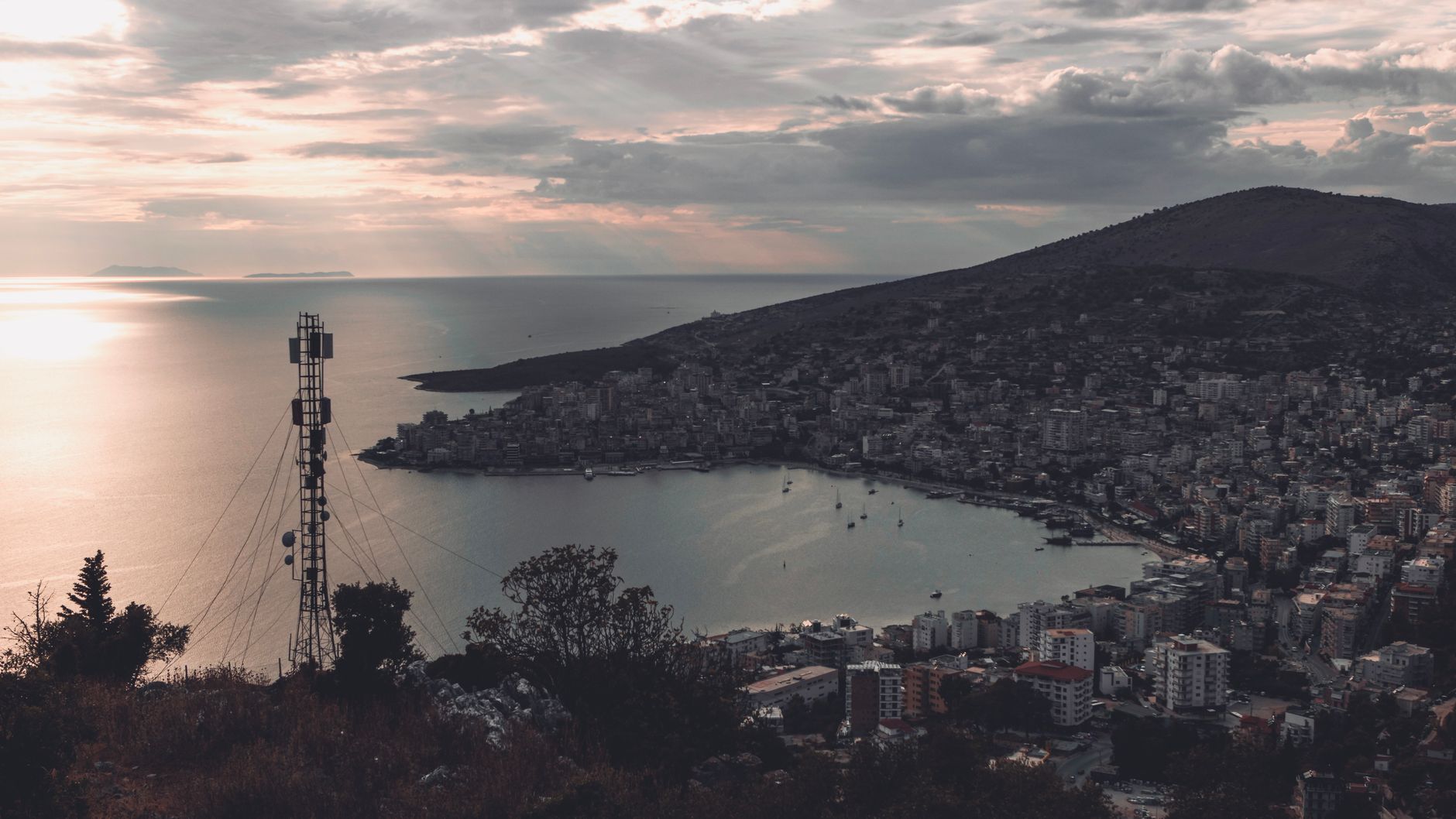
Saranda is 60 km south of Gjirokastra and arrives with a distinct change of character: after two days of grey stone and mountain air, the white resort buildings and turquoise Ionian bay feel genuinely startling. The town faces directly towards Corfu, which is close enough that the Greek island is visible on a clear day. As an overnight base, Saranda has the widest choice of accommodation on the route.
The first day is best used for Butrint National Park, 20 km south on the SH99 road. Butrint is a UNESCO World Heritage Site that contains one of the most complete sequences of ancient settlement in the Mediterranean: Greek, Roman, Byzantine, Venetian and Ottoman layers are visible above ground in a setting of lakes, lagoons and forest. The 3rd-century BC theatre is remarkably well preserved; the Lion Gate and the Roman forum are nearby. Allow 2-3 hours to cover the site properly.
The second day goes to the Blue Eye (Syri i Kaltër), 25 km east of Saranda on the road toward Gjirokastra. A natural spring of extraordinary cold clarity surges up from an underground river through a pool of brilliant turquoise-blue. The walk from the car park takes around 15 minutes through forest.
Plan for Days 5-6: Butrint on day 5 morning, Saranda beach afternoon. Blue Eye on day 6 morning, then drive to Himara.
The drive from Saranda north to Himara along the SH8 coastal road is the best driving of the trip: a succession of clifftop bends above the Ionian Sea, with small beach coves appearing below at intervals. Himara is the most characterful of the Albanian Riviera villages, with a hilltop Byzantine citadel above the modern town and beaches at Livadhi and Potami that have not been overdeveloped in the way of the more accessible resorts.
The old village above Himara is worth the 20-minute walk up: a small community of stone houses with views north along the coast. The evening is well spent at one of the seafront restaurants on Livadhi beach.
The route north from Himara follows the SH8 over the Llogara Pass at 1,027 metres, which gives panoramic views over the full length of the Albanian Riviera before the road descends to the Vlore plain and picks up the A2 Autostrada back to Tirana. The drive takes around 2.5-3 hours from Himara.
When to go: May to September. June and September have good weather and fewer crowds than July-August, when the Albanian Riviera fills with visitors from Tirana and the diaspora. The UNESCO cities are pleasant year-round; the coast is a summer destination.
Getting there: Tirana International Airport (TIA) is 17 km north of the city centre, with direct flights from most major European hubs including London Heathrow (British Airways), London Gatwick (easyJet) and several other UK and European cities.
Driving: Albania drives on the right. Roads in the south are mostly in good condition; the SH8 coastal road has some narrow sections with steep drops. Speed limits are enforced with radar. The A2 and A3 motorways between Tirana, Durres, Berat and Vlore are modern dual-carriageway standard.
Currency: Albanian lek (ALL). Cards are increasingly accepted in hotels and restaurants in cities, but carry cash for small villages, petrol stations and roadside stops. ATMs in all main towns.
Budget: Albania is one of the most affordable road-trip destinations in Europe. Expect restaurant meals for 10-15 EUR per person, hotel rooms from 50-80 EUR per night in mid-range accommodation, and petrol significantly cheaper than western European prices.
A 10-day loop from Leeds through the Yorkshire Dales, Teesdale, UNESCO Durham and the chalk cliffs and gannet colonies of East Yorkshire: one of England's most varied driving circuits.
The full route — stops, maps, and driving times — is on Routebook by Kington.

An 8-day loop from Tirana through Albania's two UNESCO World Heritage cities, the Albanian Riviera's coastal villages, and the Roman ruins of Butrint — one of Europe's most underrated road trips.


