

A seven-day self-drive loop from Edinburgh through four ruined abbeys, Floors Castle and Abbotsford House along the River Tweed. Scotland's most historic countryside, without the crowds.
Scotland's most underrated road trip loops south from Edinburgh into the Borders, a rolling landscape of green hills, river valleys and ruined abbeys that most visitors drive straight past on the way to the Highlands. This Scottish Borders road trip itinerary makes a strong case for stopping here instead: shorter driving legs than almost any other great British road trip, more historic sites per square mile than any other region in Scotland, and market towns where you can find a table for dinner without booking six weeks ahead.
Starting and finishing in Edinburgh, the loop covers around 120 miles across seven days. Drive south to Peebles (40 minutes), east to Jedburgh (50 minutes), north to Kelso (20 minutes), west to Melrose (20 minutes), then north to Edinburgh (50 minutes). No single leg takes more than an hour. This is a trip designed for lingering.
Edinburgh is the natural start and finish. Spend the first evening walking the Royal Mile from the castle down to the Palace of Holyroodhouse, or exploring the New Town's Georgian terraces. Collect your hire car from the city centre before heading south the following morning.
Forty minutes south of Edinburgh, Peebles is the ideal first overnight stop. The market town sits where the River Tweed bends through a natural valley bowl, its high street lined with independent bakers, bookshops and outdoor gear shops.
Walk upstream from the town bridge for 2 km and you reach Neidpath Castle, a 14th-century tower house perched above a river gorge. The exterior is freely accessible year-round. Cyclists can pick up the Tweed Valley Trail in town, which runs east through the heart of the itinerary all the way to Melrose. Kailzie Gardens, 3 miles east of Peebles, has a good walled garden and café for those wanting a longer stop.
Jedburgh Abbey is the finest of the four Border abbeys, with a soaring Romanesque nave that rewards careful study. Founded in 1138 by King David I and repeatedly attacked during the Border Wars, the ruins are large enough and detailed enough to feel genuinely impressive. The visitor centre does an excellent job of placing the stonework in historical context.
The town is compact and easy on foot. The Mary Queen of Scots Visitor Centre occupies the tower house where the queen stayed in 1566, the year before her forced abdication. Castle Jail, built on the site of Jedburgh's original castle in 1820, now houses a museum of rural Border life.
A 10-day southern France loop: Marseille's Calanques, Arles' Roman ruins and the Camargue, Saint-Tropez's beaches, and three nights on the French Riviera at Nice.
From Jedburgh, two half-day trips complete the picture. Carter Bar, 12 miles south on the A68, is the dramatic upland pass where the road crosses into England, with wide views across Northumberland. Dryburgh Abbey, 8 miles south-east on the Tweed, is the most peaceful of the four Border abbeys. Sir Walter Scott is buried in the north transept alongside his son-in-law John Gibson Lockhart.
The Historic Environment Scotland Explorer Pass covers Jedburgh, Dryburgh and Melrose Abbey. If you plan to visit all three plus other HES sites, the pass saves money and removes the need to queue for tickets.
Kelso has one of the finest market squares in Scotland: a broad Georgian cobbled expanse anchored by the town hall, with the River Tweed visible a short walk away. Kelso Abbey is free to visit and the most fragmentary of the four, but the cluster of surviving Romanesque stonework is still worth a brief stop.
Floors Castle, a mile west of town on the Tweed, is the largest inhabited castle in Scotland. William Adam designed the original building in 1721; William Playfair gave it its current skyline of towers and battlements in the 1840s. The walled kitchen garden is open regardless of whether you pay for house admission, and the estate café makes a good lunch stop. Smailholm Tower, a well-preserved 15th-century peel tower on a bare rocky outcrop 7 miles north-west of Kelso, is one of the most striking sites in the Borders. It sits on open moorland and inspired a young Walter Scott, who spent childhood summers at nearby Sandyknowe Farm.
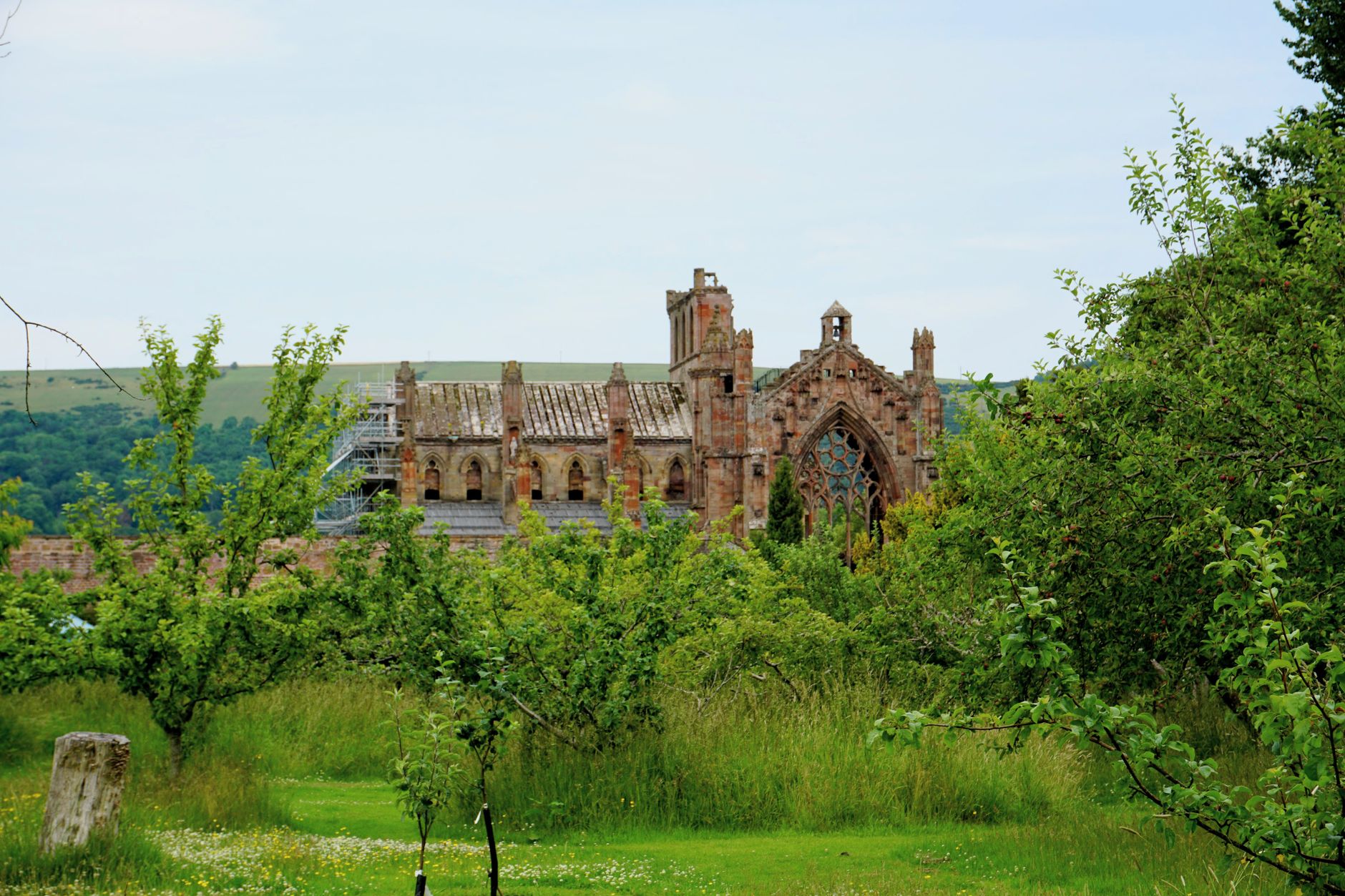
Melrose is the heart of the Scottish Borders and the natural high point of the route. Melrose Abbey, founded in 1136, is the most elaborate of the four ruined abbeys: look for the carved pig playing bagpipes on one of the roofline corbels, one of dozens of medieval grotesques scattered through the stonework. The heart of Robert the Bruce is said to be buried beneath the nave floor, marked by a stone set flush with the grass.
Abbotsford House, 3 miles west along the Tweed, is Sir Walter Scott's remarkable creation. He began building it in 1817 on the riverbank and filled it over the following years with medieval artefacts, reclaimed oak panelling and a library of 9,000 books. Scott lived here until his death in 1832, and his study is preserved largely as he left it. The visitor centre, added during the 2010s restoration, is among the best of any literary house in Britain.
Scott's View, a short drive from Melrose through the Eildon Hills, is the panoramic viewpoint Scott himself favoured. The vista takes in the full sweep of the Tweed valley with the three peaks of the Eildons rising above. According to local tradition, his horses stopped here automatically on his funeral cortege because he had paused at this spot so often in life. Go at golden hour if you can.
Priorwood Gardens, directly beside the abbey in the centre of Melrose, is maintained by the National Trust for Scotland. Entry is free and it is a peaceful place to sit after a busy day of sightseeing.
Book accommodation well ahead for weekends between May and September. Burt's Hotel in Melrose is consistently the best-reviewed property in the region. The Roxburghe Hotel near Kelso suits those wanting a country house experience. Jedburgh and Peebles both have good B&Bs at more modest prices.
Fuel is easy to find on the main A68 and A7 corridors. You will not be more than 15 miles from a petrol station at any point on this route.
The HES Explorer Pass covers Melrose Abbey, Jedburgh Abbey and Dryburgh Abbey. If you plan to visit all three, it is worth buying at the first abbey you reach.
April to October gives the best weather for driving and exploring on foot. The Common Ridings festivals, held across the Borders from May to July in towns including Hawick, Selkirk and Galashiels, fill accommodation rapidly and are well worth planning around if you can. September is a particularly good month: quieter than peak summer, warm afternoons and the Tweed valley beginning to show autumn colour.
Winter visits are possible. Most abbeys remain open but keep reduced hours, and the Borders landscape has a starker, quieter quality that suits the region's character well.
A 10-day loop from Leeds through the Yorkshire Dales, Teesdale, UNESCO Durham and the chalk cliffs and gannet colonies of East Yorkshire: one of England's most varied driving circuits.
The full route — stops, maps, and driving times — is on Routebook by Kington.

A 5-day self-drive loop through Scotland's most historic countryside, linking four ruined abbeys, Floors Castle and Abbotsford House along the River Tweed.
 Routebookby Routebook


