

Follow the River Wye from Hereford through limestone gorges, medieval ruins and castle towns to the legendary bookshops of Hay-on-Wye on this 4-day loop through England's border country.
The Wye Valley road trip itinerary in this guide covers 130km of England and Wales in four days, following the River Wye from Hereford south through limestone gorges and medieval ruins, then northwest through the Black Mountains to the legendary bookshop town of Hay-on-Wye. All driving distances are short; this is a route built for slowing down.
The valley straddles the English and Welsh border, which means the character of the route shifts as you drive. The English market towns of Hereford and Ross-on-Wye give way to the wilder limestone gorge at Symonds Yat, the Welsh border towns of Monmouth and Tintern, and then the Black Mountains. It is a small area with a lot of variety.
The best months are April to October. Spring brings wildflowers along the riverbanks and bluebells in the Forest of Dean. Early autumn turns the oak woods lining the gorge copper and amber. The Hay Festival at the end of May brings large crowds to Hay-on-Wye; book well ahead or avoid that period entirely.
You need a car. Hereford has direct trains from London Paddington (about 2.5 hours) and from Cardiff (about 50 minutes). Hire car firms operate from the station. The route returns to Hereford, so there is no need to arrange a one-way drop-off.
All drives on this itinerary are short. The longest single day is the drive from Hereford to Hay-on-Wye via Tintern and Abergavenny; everything else is measured in a handful of miles. Most of your time is spent on foot or on the water rather than behind the wheel, leaving room to walk, canoe or simply stay longer at a lunch stop that earns it.
Hereford needs two nights, not as a concession to inertia but because the Cathedral alone merits a proper visit, and the city makes the natural base for exploring the lower valley. The Mappa Mundi, drawn on a single sheet of calf skin around 1300, sits in a climate-controlled room off the south transept. Jerusalem is at the centre of the map. Britain and Ireland are squeezed into the lower-left corner, recognisable but warped. The Chained Library next door holds 1,500 books, each secured by a chain to the shelf, ranging from a 9th-century gospel to a 17th-century atlas.
The Old House on High Town is a 1621 Jacobean timber-framed building that has survived while everything around it was demolished. It is now a museum and free to enter. The Cider Museum on Ryelands Street covers the county's defining industry with a seriousness and depth that repays the hour it takes.
The River Wye runs south of the city centre. The Wye Valley Walk runs along the west bank; a flat afternoon walk upstream reaches Hunderton Weir in about an hour.
With two nights here you can take in the best of the lower valley as day trips, all within a short drive of the city.
A 10-day southern France loop: Marseille's Calanques, Arles' Roman ruins and the Camargue, Saint-Tropez's beaches, and three nights on the French Riviera at Nice.
The 24km drive south from Hereford takes under 35 minutes on the A49. Ross sits on a sandstone cliff above a horseshoe bend in the Wye, and the view from the churchyard of St Mary's Church is the reason the town became one of the starting points for the Picturesque tourism movement in the 18th century.
The red sandstone Market House of 1650 stands on columns in the centre of the main square. The Thursday and Saturday markets still run from the same building. In the churchyard, the Plague Cross of 1637 marks the graves of 315 people who died in a single outbreak; it is a sobering marker in a pleasant town.
Canoe hire firms in Ross offer the classic section downstream to Symonds Yat: a 12km paddle through the gorge that takes about three hours and involves no weirs. No prior experience is required. This is one of the better afternoons on the route.
Goodrich Castle is 5km south of Ross on the A40, and it earns the detour. The English Heritage site preserves the keep, towers and curtain walls in better condition than most Norman castles in England. Allow 90 minutes.
The viewpoint at Symonds Yat Rock sits on a limestone cliff at the edge of the Forest of Dean, 90 metres above the River Wye. The river bends through a 6km horseshoe below, framed by steep oak woodland. The ruins of Goodrich Castle are visible in the trees across the valley.
RSPB volunteers operate telescopes at the viewpoint in spring and summer to help visitors spot the peregrine falcons that have nested on the rock face for decades. The falcons are typically present from March to late August.
The Forest of Dean walking trails begin from the same car park. The longer routes loop through ancient oak forest that has been managed since the 11th century. The waymarked Peregrine Trail takes about 3km and stays close to the viewpoint.
The hand-pulled chain ferry across the Wye connects to the Saracen's Head Inn on the opposite bank. It runs in summer and makes a good lunch stop, easily paired with Ross-on-Wye or Monmouth on the same day out.
The A466 follows the River Wye south to Monmouth, a short hop from Symonds Yat just 15km north and an easy run from the Hereford base. Henry V was born in Monmouth Castle in 1387, and the substantial round tower and great hall survive as a ruin in the care of the town museum. Entry is free.
Monnow Bridge at the south end of the town is the route's most visually arresting piece of medieval architecture outside Tintern. The 13th-century fortified gatehouse sits at the centre of the bridge over the River Monnow; it is the only surviving example of a fortified bridge in Britain, and it still carries road traffic.
Monmouth is a good town for lunch or an early dinner. Agincourt Street has independent restaurants rather than chains, and the town is large enough to have a range of options without being big enough to feel anonymous.
Leave Hereford and head south down the valley, taking in Tintern Abbey before the road turns northwest through the Black Mountains to Hay-on-Wye. It is the longest driving day on the route, but still an unhurried one.
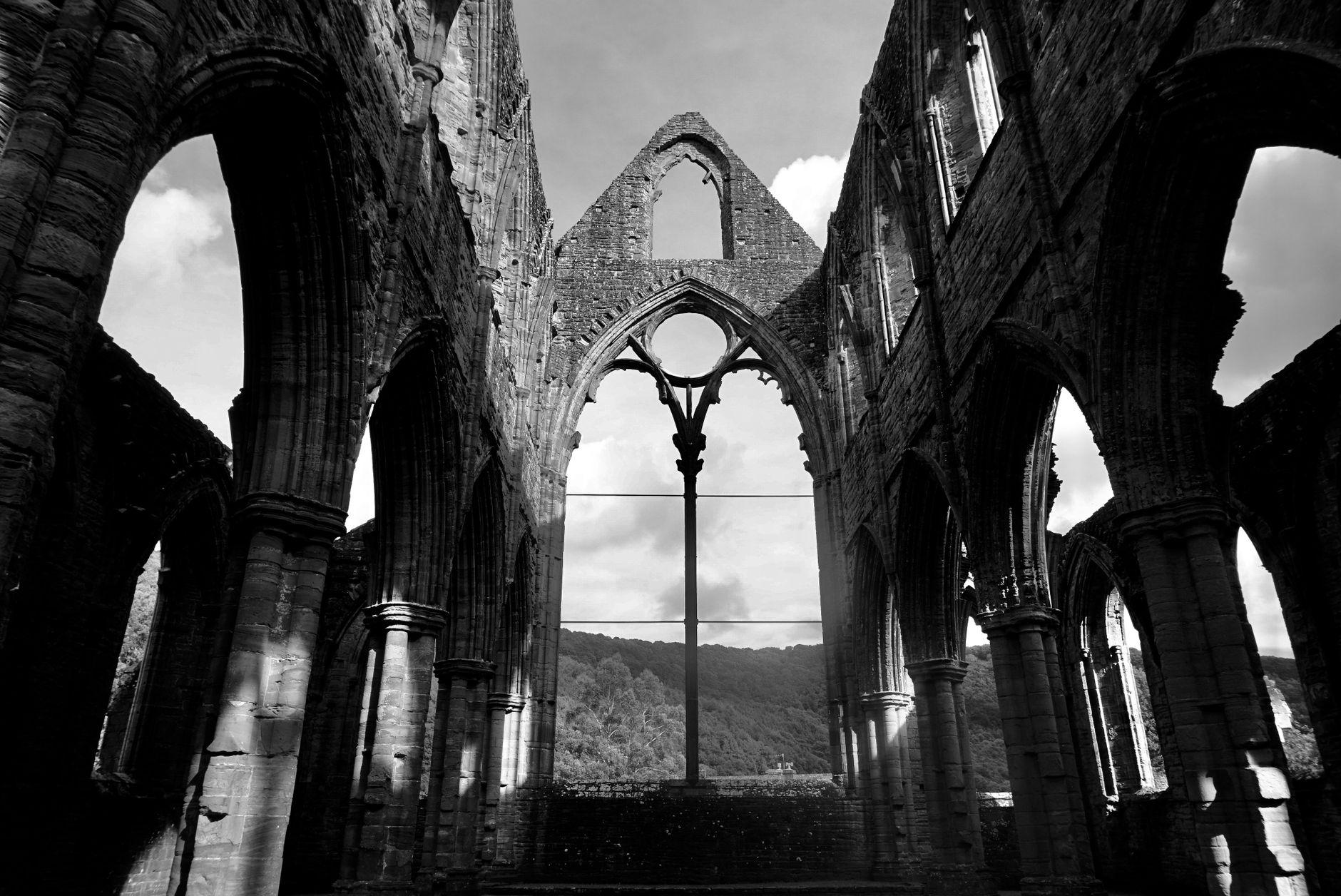
Tintern Abbey was founded by Cistercian monks in 1131, suppressed by Henry VIII in 1536, and then left to decay for 250 years before Wordsworth arrived in 1798 and wrote the poem that made the ruins famous. J.M.W. Turner visited the same year and painted the scene from the hillside above.
The Gothic arches of the church still stand close to their original height in a bend of the river, surrounded by steep wooded hills. The site is managed by Cadw, the Welsh historic monuments agency. Entry costs around £8 for adults; Cadw members enter free.
The Old Station at Tintern, converted into a visitor centre and cafe with riverside seating, is a good place to spend an hour after the Abbey. The Devil's Pulpit is a limestone rock outcrop above the valley with a clear view down to the ruins. The approach is a 45-minute walk through beech wood from the Old Station car park on a well-marked path.
From Tintern the road climbs northwest via Abergavenny and the A479 through Talgarth, crossing the edge of the Black Mountains before dropping into the upper Wye valley near Hay.
Hay-on-Wye has more than 30 independent bookshops in a town of under 2,000 people. The concentration makes no conventional commercial sense, which is part of why it works. Richard Booth's Bookshop in a former cinema is the largest and the most chaotic, with shelves running across three floors and into the cinema balcony. The secondhand books across the town number over a million.
Richard Booth, who died in 2019, declared Hay-on-Wye an independent kingdom in 1977 with himself as king. The stunt generated enough publicity to establish the town's reputation, and the Hay Festival, launched in 1988, confirmed it. The festival in late May draws speakers including Nobel Prize winners, former heads of state and leading novelists. It fills accommodation across a 30km radius; either plan your visit around it or avoid that period.
With one night in Hay, spend what remains of the day among the bookshops and the town's cafes and pubs before settling in.
The A438 east from Hay-on-Wye returns to Hereford in under 45 minutes. If the weather is clear and you have time before the drive, the Gospel Pass (B4423) climbs from Hay over the Black Mountains to the south, reaching one of the highest road passes in Wales; the panorama back over Hay and the Wye valley stretches far to the east before the road descends past Llanthony Priory. Back in Hereford, the Cider Museum on Ryelands Street works as a final stop if you did not visit it at the start of the trip. Hereford station is a short walk from the centre.
Getting there: Hereford station has direct trains from London Paddington (2.5 hours) and Cardiff Central (50 minutes). Hire car firms operate from the station.
Best time: April to October. The Hay Festival at the end of May fills beds for 30km around; book months ahead or avoid that window.
Fuel: Hereford, Ross-on-Wye, Monmouth and Hay-on-Wye all have fuel stations. Tintern village has none; fill up in Monmouth before the short drive south.
Canoeing: Hire firms in Ross-on-Wye and Symonds Yat offer same-day bookings for sections of the Wye. No experience required for the lower river.
Tintern Abbey: Entry via Cadw. Cadw and English Heritage members enter free. Chepstow, 11km south, has more accommodation and a castle of its own.
Hay-on-Wye bookshops: Most close on Sundays and some on Mondays. Check individual shops before making a long drive specifically for one title.
A 10-day loop from Leeds through the Yorkshire Dales, Teesdale, UNESCO Durham and the chalk cliffs and gannet colonies of East Yorkshire: one of England's most varied driving circuits.
The full route — stops, maps, and driving times — is on Routebook by Kington.

A 4-day loop from Hereford along the River Wye to medieval abbey ruins, the Symonds Yat gorge viewpoint, castle towns and the legendary bookshop streets of Hay-on-Wye.
 Routebookby Routebook

