

A six-day loop from Aberdeen through Scotland's castle country, the Royal Family's Deeside valley, Speyside distilleries and the Moray fishing coast.
Scotland's northeast is almost always skipped in favour of the NC500 or the West Highland route. That is a mistake. This six-day Aberdeenshire road trip itinerary runs from Aberdeen through a corridor of clifftop castles, the Royal Family's favourite river valley, Europe's greatest concentration of malt whisky distilleries, and a Moray coast where fishing villages sit beneath Victorian railway viaducts. The driving distances are short, the roads are good, and almost everywhere you stop, you have the place largely to yourself.
The best months are May to September. The A939 mountain pass over the Lecht sits above 600m and closes in heavy snow between November and April. June and July are the warmest months; late September brings golden birch forests along the Dee valley.
You need a car. Aberdeen has direct trains from Edinburgh in 2.5 hours and from Glasgow in the same time. Pick up a hire car at the station or airport and return it at the end. Aberdeen Airport has direct flights from London Heathrow, Amsterdam and Manchester.
This itinerary runs anticlockwise: south to Stonehaven, west along the Dee to Braemar, north over the mountains to Speyside, then east along the coast. You can reverse it without difficulty.
Aberdeen is not just a gateway. The Old Town clusters around King's College (founded 1495) and St Machar's Cathedral; a 20-minute walk brings you to Marischal College, one of the world's largest granite buildings and now the city's civic headquarters. Take the afternoon for Footdee (locally called Fittie), the original fishing village at the harbour mouth where cottages still face inward against the prevailing wind.
Aberdeen Maritime Museum on Shiprow covers clipper ships and North Sea oil with equal candour. Aberdeen Art Gallery is genuinely good. The beach stretches 2 miles north of the harbour: not a swimming beach by anyone's definition, but a fine place for a walk before dinner. Basing yourself here leaves room for both the city and a day trip down the coast.
A 10-day southern France loop: Marseille's Calanques, Arles' Roman ruins and the Camargue, Saint-Tropez's beaches, and three nights on the French Riviera at Nice.
On your second day, drive the 25km south from Aberdeen (30 minutes) to Dunnottar Castle. It stands on a 160ft sea stack, separated from the cliff path by a narrow neck of land. You walk down to the beach level and up the other side to reach the gatehouse. In 1651, Scotland's Crown Jewels were hidden here when Cromwell's army occupied the Lowlands; the castle held out for eight months. Allow at least two hours to explore properly.
Back in Stonehaven's old harbour, seafood restaurants line the waterfront. The Art Deco open-air pool on the seafront is open May to September and books out fast; the evening swims are particularly popular. It is a short drive back to Aberdeen for the night.
The A93 west from Aberdeen runs the length of Royal Deeside, and it is one of Scotland's finest driving roads though it rarely appears on that list — a little over an hour of increasing grandeur as the Dee valley narrows and the hills close in. Ballater is the quiet market town that serves as the best base for the valley.
The Old Royal Station on Station Square has been beautifully restored. The Royal Family arrived here from London for summers at Balmoral Castle until Beeching cuts closed the line in 1966. Balmoral Estate opens from April to late July (the family arrives in August); the grounds and ballroom are worth the short drive from Ballater. Crathie Kirk, across the road from the Balmoral gates, is the small church the family use on Sunday mornings when in residence.
For the best walking on the route, drive 45 minutes south from Ballater to Loch Muick: a glacial loch ringed by peaks with a circular path of around 13km. Crowds are rare outside summer weekends. Basing yourself in Ballater, you can give Balmoral and Loch Muick a day each, or pair one with the Braemar day trip below.
The 27km from Ballater to Braemar follows the Dee upstream through increasingly alpine scenery. Braemar is the last village before the mountains.
Braemar Castle, a 17th-century star-shaped fortress, runs guided tours through its well-preserved interior. The village is best known for the Braemar Gathering, held every September: the most famous Highland Games in Scotland, attended by the Royal Family and drawing competitors from across the country.
The Linn of Dee, a 5km drive west, is the highlight of the trip out. The River Dee squeezes through a narrow gorge of polished granite before widening into moorland. The path continues into the Cairngorms towards the Lairig Ghru pass if you want to extend the walk significantly. Return to Ballater for the night.
Before leaving Ballater, check conditions for the A939. This mountain road over the Lecht is one of Scotland's highest and closes in snow. The A939 north is one of the great Scottish mountain drives: the road climbs past the Lecht ski centre to 635m before dropping through heather moorland into Strathdon. Allow around two hours in good conditions. Stop at the viewpoints near the top: the Cairngorms spread out behind and Speyside lies ahead.
Dufftown has been calling itself the malt whisky capital of the world for some time, and the claim is defensible: seven distilleries operate within a few miles. Glenfiddich, at the north edge of town, is the world's most popular single malt Scotch and one of very few distilleries still owned by the founding family. Standard tours are free. Next to the distillery car park, Balvenie Castle is a 14th-century moated ruin that rarely attracts the same queues as the whisky.
The Speyside Cooperage at Craigellachie, 5km north, demonstrates how barrels are still made and repaired by hand. Mortlach Church, a short walk from Dufftown's town square, is reputedly the oldest Christian site in Scotland. Dufftown is small, so book your accommodation here early in summer.
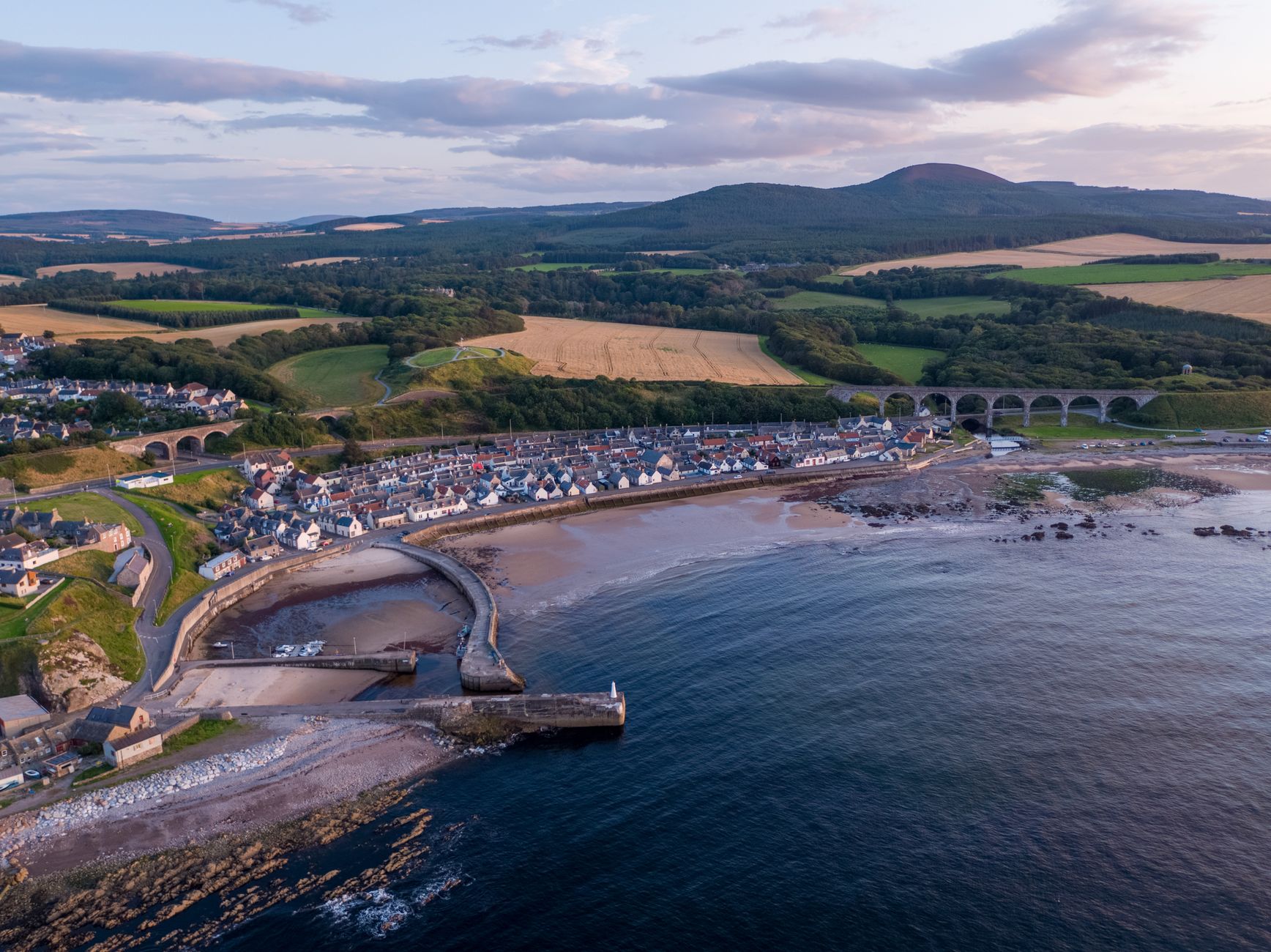
Leaving Dufftown, the 40km coast road brings you to Cullen, one of the most distinctively arranged villages in Scotland — worth a stop on the drive home. Seatown, the old fishing quarter, is sandwiched between the sea and a series of large stone railway viaducts. When the Victorian railway was planned, the Countess of Seafield refused to allow the line to follow the easier coastal route near her estate, so the engineers built the viaducts over the town instead. The result is extraordinary.
Cullen is the birthplace of cullen skink, the smoked haddock, potato and onion soup found on menus across Scotland. Trying it here, made with local smoked haddock, matters — and makes a good lunch stop.
Bow Fiddle Rock lies 2km east along the A98 towards Portknockie: a natural quartzite arch that curves over the sea. A short coastal path from the village drops to a viewpoint directly above the rock.
From Cullen the A98 and A96 return you to Aberdeen in around 90 minutes. A possible last stop: the Bin Forest viewpoint above Huntly gives a final look over Aberdeenshire before the city reappears. Return the hire car, catch the train, or fly from Aberdeen Airport.
Getting there: Aberdeen has direct trains from Edinburgh (2.5hrs) and Glasgow (2.5hrs). Aberdeen Airport connects to London Heathrow, Manchester and Amsterdam.
Best time to visit: May to September. October brings golden birch leaves on Deeside but shorter days. Avoid the A939 between November and April without checking conditions first.
Fuel: Fill up in Aberdeen, Ballater, Braemar and Dufftown. The stretch between Ballater and Dufftown via the Lecht has no petrol stations for around 60km.
Whisky visits: Book Glenfiddich tours online in advance. The Speyside Whisky Festival in April fills accommodation weeks ahead.
Accommodation: Ballater has the widest choice for Deeside nights. Dufftown is small; book early in summer.
A 10-day loop from Leeds through the Yorkshire Dales, Teesdale, UNESCO Durham and the chalk cliffs and gannet colonies of East Yorkshire: one of England's most varied driving circuits.
The full route — stops, maps, and driving times — is on Routebook by Kington.

A 6-day loop from Aberdeen through Scotland's castle country, the Royal Family's Deeside valley, Speyside distilleries and the Moray fishing coast.
 Routebookby Routebook


