

A 7-day self-drive loop through Alsace wine country: Strasbourg, medieval wine villages, Riquewihr's perfect half-timbered streets, and Colmar's Petite Venise.
The Route des Vins d'Alsace is one of France's oldest and most celebrated driving routes: 170 kilometres of wine villages, ruined châteaux, and half-timbered streetscapes running between the Vosges foothills and the Rhine plain. This Alsace road trip itinerary covers the best of it in seven days, starting and finishing in Strasbourg and spending two full nights in Colmar at the end.
The driving is short and unhurried throughout. Every leg on the wine route itself is under 50 km, and the villages are close enough that you can stop at a cellar, taste through four wines, and still reach the next town before lunch. This is France's most driveable wine region.
Alsace sits at a crossroads. It was German until 1918, French before that, German again from 1940 to 1944, and French ever since. The architecture, cuisine, language (patois Alsacien is still spoken by older residents), and wine styles all reflect that mixed history. You eat tarte flambée and choucroute garnie, not steak-frites. You drink Riesling and Gewürztraminer from tall green-glass bottles, not Burgundy or Bordeaux.
The villages of Riquewihr, Kaysersberg, Eguisheim, and Hunawihr were spared the worst of the Second World War and survive with their 16th-century cores largely intact. This makes Alsace genuinely unlike anywhere else in France.
Stay the first night in Strasbourg. The Grande Île, the historic island in the Ill River, has been a UNESCO World Heritage site since 1988. Walk from the Notre-Dame Cathedral (Gothic, with its 142-metre spire and famous astronomical clock) through the old city and into Petite France, the former tanner's quarter, where covered bridges and mill weirs frame a view that barely changes from the postcards.
Book dinner at a traditional winstub, an Alsatian pub-restaurant where the house wine is poured in small ceramic jugs and the menu runs to tarte flambée (thin-crust with crème fraîche and lardons), baeckeoffe (slow-cooked meat and potato stew), and kougelhopf (sweet yeast cake) for dessert.
Drive 32 km south from Strasbourg to Obernai, one of the best-preserved medieval market towns in Alsace. The central Place du Marché is ringed by gabled guild houses, a 13th-century belfry tower, and a 16th-century well. Park here for the morning, explore the streets, then use the afternoon to drive slowly through the wine villages (Barr, Mittelbergheim, Andlau) before reaching the hotel.
Stop at any cellar showing a 'dégustation gratuite' sign. Most family domaines offer free tastings, and buying a bottle or two directly from the producer is the best value wine shopping you will find on the route.
A 10-day southern France loop: Marseille's Calanques, Arles' Roman ruins and the Camargue, Saint-Tropez's beaches, and three nights on the French Riviera at Nice.
Drive 45 km south (about 50 minutes on the D1bis wine road, slower if you stop). Ribeauvillé is one of the most important wine towns in Alsace: the Ribeaupierre family owned three castles in the hills above the town, the ruins of which are still visible and walkable. The route up takes about 45 minutes on foot and gives panoramic views over the vine-covered plain.
The grand rue is lined with half-timbered houses and wine shops. The Thursday morning market draws locals from across the valley and is a good place to buy local cheese and charcuterie for a vineyard picnic.
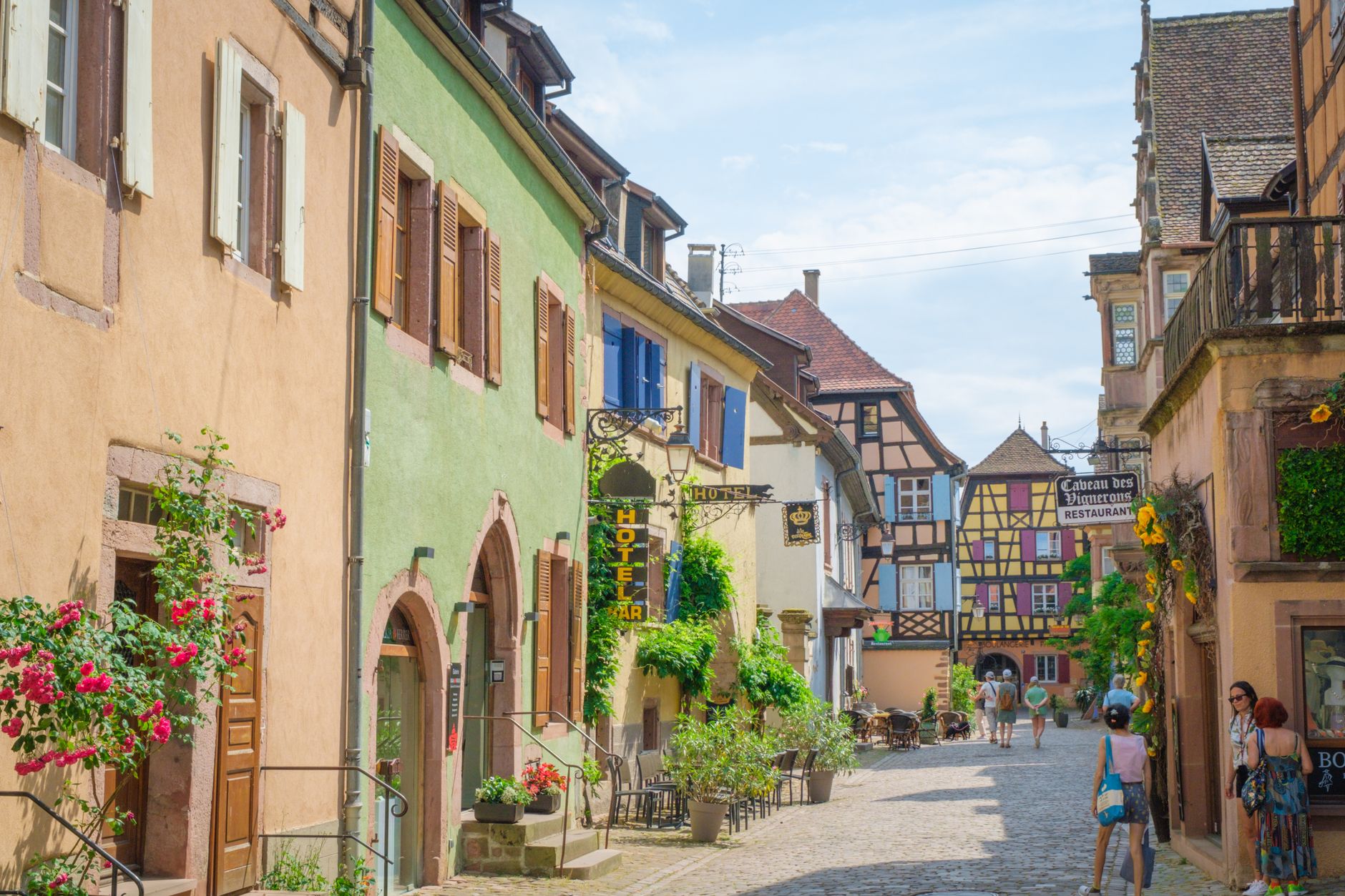
Riquewihr is only 5 km south of Ribeauvillé, but it deserves a full overnight. The village is one of the best-preserved in France: a complete 16th-century wine town within intact medieval ramparts, with the Dolder Tower gate and the Thieves' Tower still standing, and the main street (Rue du Général de Gaulle) car-free and almost entirely unchanged from the 1500s.
The crowds are real in July and August. Arrive before 10am or after 4pm to see the street without tour groups; the light in late afternoon is better for photography in any case. Most visitors pass through as a day trip from Colmar; staying overnight gives you the village to yourself in the evenings.
Colmar is 13 km south of Riquewihr, and it is where the route reaches its peak. The Petite Venise quarter, where brightly painted fishermen's houses from the 15th and 16th centuries overhang the Lauch River channels, is the most photographed place in Alsace. The light is best in the early morning or the golden hour before sunset.
Spend one of the two days in the Unterlinden Museum. The Isenheim Altarpiece by Matthias Grünewald (1512–1516) is its centrepiece: a massive polyptych painted for a monastery hospital treating skin diseases, with an imagery intensity that has to be seen in person. Book tickets in advance in summer to avoid queues. Allow at least two hours.
Use the second day in Colmar to range out to nearby villages you haven't seen: Eguisheim, Kaysersberg (Albert Schweitzer's birthplace), and Hunawihr are all within 15 km and each is worth an hour.
The A35 motorway north from Colmar to Strasbourg covers 75 km in under an hour. Allow 90 minutes before a flight to return the hire car and clear the airport. Strasbourg's TGV station connects directly to Paris in 2 hours 20 minutes if you are continuing your France trip by rail.
May to September is the main season, with the vines in full leaf and all cellars and restaurants open. September and October bring the Vendanges (harvest) festivals across the villages. Strasbourg's Christmas market, operating since 1570, runs from late November into December and is one of the most atmospheric in Europe, though the town is very crowded.
Rent from Strasbourg Airport or the TGV station. A small car is ideal for the wine route's narrow village streets. The A35 motorway (toll-free) runs parallel to the wine route and makes it easy to skip ahead if needed.
A mid-range budget of around €100 to €150 per person per day covers a comfortable hotel or guesthouse, meals, and a reasonable amount of wine. Most winery tastings are free. The Unterlinden Museum costs €15 per adult. Alsace is generally good value compared with Paris or the Côte d'Azur.
A 10-day loop from Leeds through the Yorkshire Dales, Teesdale, UNESCO Durham and the chalk cliffs and gannet colonies of East Yorkshire: one of England's most varied driving circuits.
The full route — stops, maps, and driving times — is on Routebook by Kington.

A 5-day self-drive loop along the Alsace Route des Vins: from Strasbourg's UNESCO World Heritage centre south through medieval wine villages to Colmar's Petite Venise canal quarter, with vineyard stops, ruined châteaux, and some of the finest wine in France.
 Routebookby Routebook


