

From Cambridge's Gothic spires to Ely's cathedral rising above the flat Fens, this journey through Cambridgeshire takes in Bronze Age causeways, a Norman cathedral with a theatrical three-arched West Front, and Stamford, England's finest stone town.
Cambridge has a way of stopping time. You're walking along the Backs, the garden strip behind the old colleges, and suddenly there are students punting past the Mathematical Bridge. The fan vaults of King's College Chapel glow above the willow trees. A city of 31 colleges has been building itself here since 1209, and most of it remains.
This four-day journey pulls you out of Cambridge and into country many visitors never reach: the flat, luminous Fens; a cathedral town so remote its great church is visible from 30 kilometres; an industrial city that hides one of the best Norman facades in England; and a stone market town that has been calling itself England's finest for 300 years. The route ends at Stamford, which is hard to argue with.
The region rewards patience and a car. The Fens look uniform from above but reveal themselves slowly: the enormous sky, the drainage channels running arrow-straight, the sudden rise of a cathedral on what passes for a hill. None of it is accessible by rail except Cambridge itself; a car is the only way to connect these dots.
Cambridge is the draw and the base, but the route's real discovery is the run north-west from Cambridge through Peterborough to Stamford. In a single day on the road you pass through 3,500 years of English history from Bronze Age fenland to Elizabethan grandeur, with barely an hour between each stop.
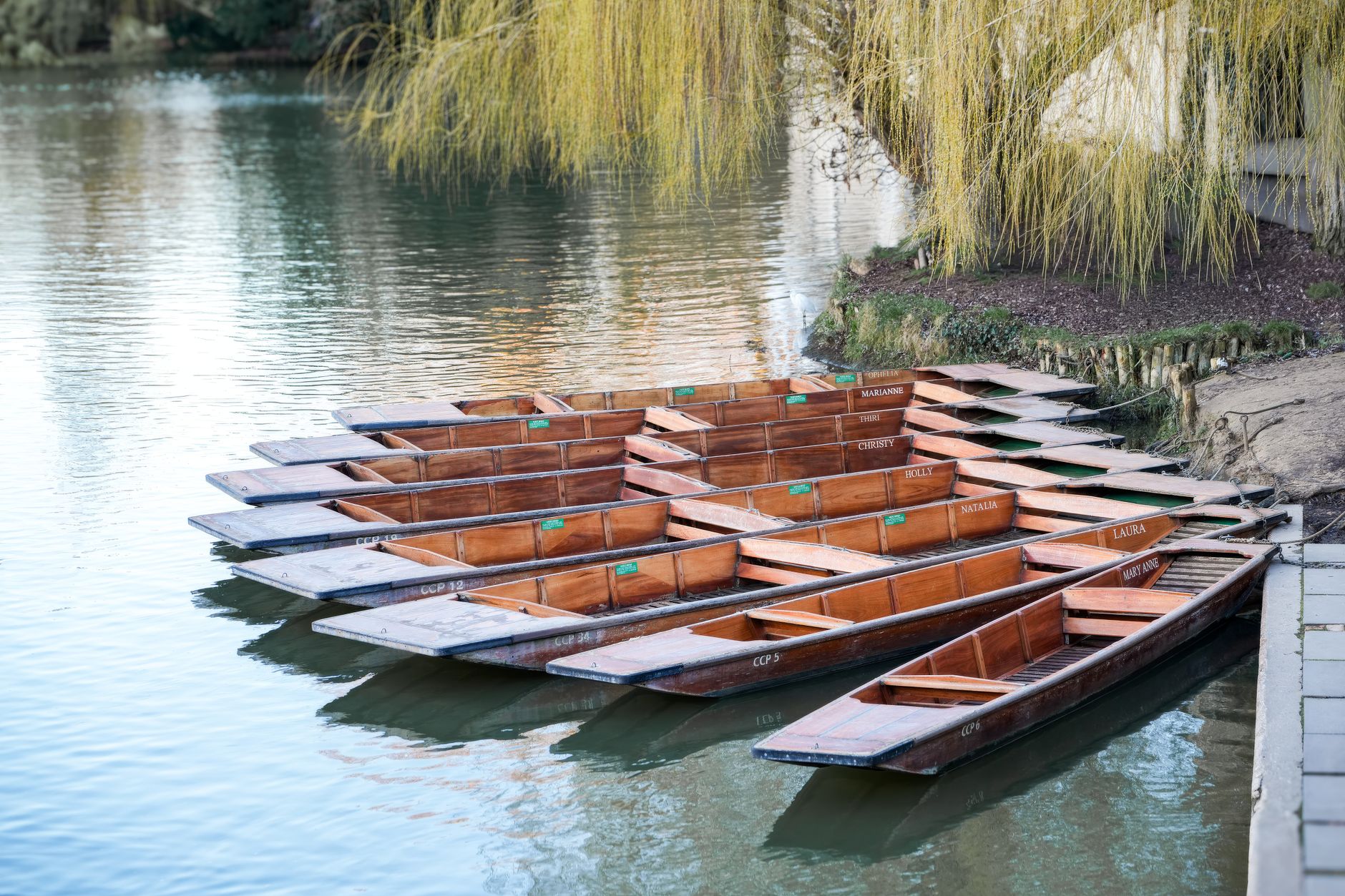
Two full days is the minimum for Cambridge, and a third is better if the Fitzwilliam Museum pulls you in. Start on the Backs: walk the path between the river and the college gardens, cross the wooden Mathematical Bridge at Queens' College, look for the gargoyles on King's. King's College Chapel opened in 1547 after 100 years of construction; the fan-vaulted ceiling is the world's largest, completed under Henry VIII. The Rubens altarpiece, donated in 1961, adds a note of baroque surprise.
The Fitzwilliam Museum on Trumpington Street is free and worth two hours: Egyptian mummies, Greek red-figure pottery, Impressionist paintings, and 16th-century armour. The Museum of Zoology on Downing Street has a full blue whale skeleton suspended from the ceiling.
On the first afternoon, hire a self-hire punt from Silver Street Bridge and spend an hour on the water. Then take the Grantchester meadows path south along the towpath, 3 km to the village Rupert Brooke immortalised. The Orchard Tea Garden has been serving cream teas since 1897.
Give the second day to Ely, an easy 26 km north on the A10 (about 35 minutes each way) and an effortless day trip from Cambridge.
A 10-day southern France loop: Marseille's Calanques, Arles' Roman ruins and the Camargue, Saint-Tropez's beaches, and three nights on the French Riviera at Nice.
The first thing you notice is that you can see it. The cathedral appears above the flat Fens as you drive north on the A10, a pointed Gothic silhouette visible from 10 kilometres away. By the time you park in Ely this feels significant: you've crossed the fenland, and the cathedral has been watching your arrival for 20 minutes.
Inside, the nave is 76 metres long. But the octagonal lantern tower is the real achievement. In 1322 the original Norman crossing tower collapsed. The master mason Alan of Walsingham replaced it with an octagon spanning 21 metres, topped with a timber lantern weighing 400 tonnes. Nothing like it exists elsewhere in medieval architecture. Guided tours of the octagon climb into the lantern gallery.
Oliver Cromwell's House is five minutes' walk on the market place. Cromwell lived here from 1636 to 1647 while collecting the Isle of Ely's church tithes. The Tudor timber-framed building is now a museum with period rooms and an audio guide about daily life in the 1640s. The Stained Glass Museum occupies the south triforium of the cathedral and holds 800 years of glass, from medieval fragments to 20th-century studio work. Then it's back to Cambridge for a second night.
Leave Cambridge after breakfast and head north-west; Peterborough, about 50 minutes away on the A14 and A1, is the natural stop on the drive to Stamford.
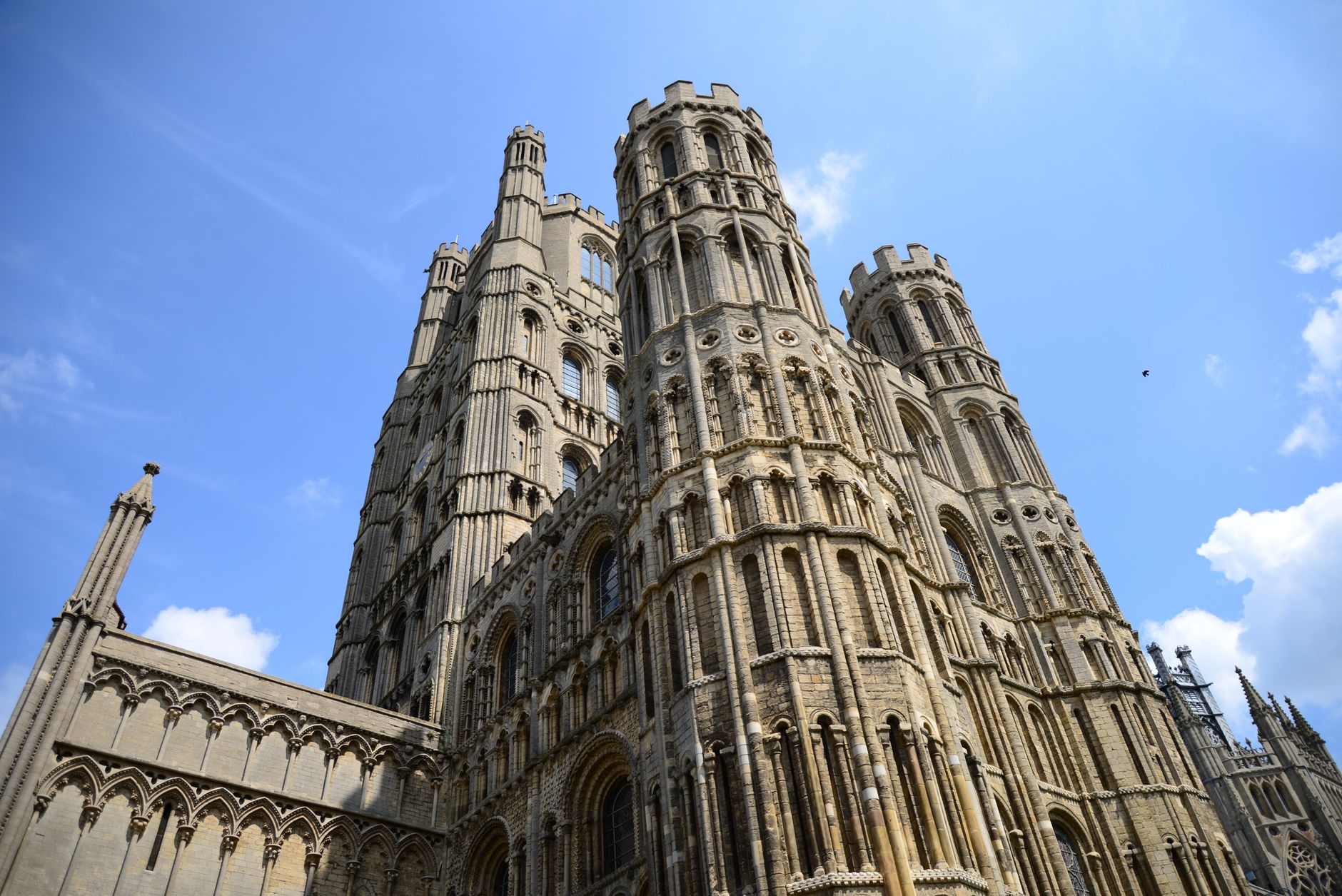
Peterborough Cathedral's West Front, three soaring Early English arches built between 1195 and 1230, is one of the most theatrical entrances to any English building. Inside, the painted timber nave ceiling is a 12th-century original, one of only two surviving medieval painted timber ceilings in Europe (the other is at Hildesheim in Germany). The north aisle contains the tomb of Katharine of Aragon, Henry VIII's first wife, who died at nearby Kimbolton Castle in 1536.
Flag Fen, 4 km east of the city on the A47, takes more imagination. The Bronze Age causeway of 60,000 oak timbers was laid across the wetland 3,500 years ago, not as a road but as a barrier and ritual site; votive offerings of swords, jewellery and tools were thrown into the water beside it. The Preservation Hall pumps water continuously over a section of the original timbers to prevent decay. Open late March to September.
Drive on to Stamford: A47 west to the A1, 29 km, about 25 minutes.

Stamford is the route's centrepiece, and even a single night here rewards the detour. England designated it the country's first conservation area in 1967, and you understand why within five minutes of parking. The entire medieval street grid survives, built in local limestone that turns honey-gold in afternoon light. Sir Walter Scott called it 'the finest sight on the road between Edinburgh and London.'
There are five medieval churches in a town of 20,000 people, and at least 600 listed buildings. Several BBC period dramas have been filmed here when the production needed a Georgian or medieval street: Middlemarch (1994), Pride and Prejudice (1995), and Wolf Hall.
Spend what's left of the afternoon exploring the town on foot. The high street passes All Saints' Church and St Mary's before rising to St Martin's and the stone bridge over the River Welland. Stamford Arts Centre occupies a 17th-century converted chapel in St Mary's Street.
Give the final morning to Burghley House, 1 km south of the town. William Cecil, Elizabeth I's chief minister for 40 years, built it between 1555 and 1587. The 18 state rooms contain paintings by Verrocchio, Gainsborough and Jan Steen; the Heaven Room has a ceiling by Antonio Verrio that covers walls, ceiling and fireplace in a continuous classical scene. Outside, Capability Brown redesigned the park in 1756, creating the lake and the tree planting that surrounds the house. The grounds are free and open year-round; the house opens most days from April to October. Parking on site is free.
If you have time before heading home, Rutland Water lies 20 km west — England's largest reservoir by surface area, in the country's smallest county. The cycling route around its perimeter is flat and well-surfaced, and you can hire bikes at Whitwell on the north shore; ospreys nest here from April to August and can be watched from the Lyndon Reserve on the south shore. Oakham, Rutland's county town, adds a medieval castle hall with an extraordinary collection of horseshoes presented by visiting royalty.
Stamford is 25 km from Peterborough on the A47, giving easy access to East Midlands Railway trains back to Cambridge (40 minutes) and London St Pancras (50 minutes). If you're keeping the car, Cambridge is an hour's drive east via the A47 and A14.
Driving: All legs are under an hour. Total driving across the trip is a little over 100 km. The A10 and A47 are fast dual carriageways.
Accommodation: You only need beds in two places. Cambridge has the widest choice, from university-linked B&Bs to larger hotels. Stamford has excellent independent B&Bs and the George of Stamford, a coaching inn on the high street.
Parking: Free in Stamford (St Peter's Hill car park); moderate in Peterborough; scarce and expensive in Cambridge (use the Park and Ride on A14 or A1307).
Flag Fen is seasonal (late March to September only); plan accordingly for a winter visit.
Is this route suitable in winter? Cambridge, Ely and Peterborough cathedrals are year-round. Burghley House closes from late October to March; Flag Fen closes in winter. Stamford is particularly atmospheric in December with its Christmas markets.
How much does it cost? Budget around GBP 30-50 per person per day for mid-range accommodation. Free: Peterborough Cathedral, Cromwell Museum, Fitzwilliam Museum. Paid: Ely Cathedral (around GBP 10-12), Burghley House (around GBP 18-20), Flag Fen (around GBP 7), King's College Chapel (around GBP 10), Rutland Water bike hire (around GBP 15-20 per day).
How do I return to Cambridge at the end? Peterborough, 25 km from Stamford, has frequent East Midlands Railway trains to Cambridge (about 40 minutes). Alternatively, drive back along the A47 and A14, which takes just under an hour.
A 10-day loop from Leeds through the Yorkshire Dales, Teesdale, UNESCO Durham and the chalk cliffs and gannet colonies of East Yorkshire: one of England's most varied driving circuits.
The full route — stops, maps, and driving times — is on Routebook by Kington.

A 4-day journey from Cambridge through the Fens to Stamford, taking in Gothic cathedrals, a Bronze Age causeway, and England's finest stone town.

