

An 8-day Great Smoky Mountains loop from Knoxville: Cades Cove wildlife, the drive over Newfound Gap to Kuwohi, Cherokee heritage, and the Nantahala Gorge.
The Great Smoky Mountains are the most visited national park in the United States, and a loop from Knoxville is the most rewarding way to see them. This Great Smoky Mountains road trip itinerary circles the park over eight days, crossing the high crest at Newfound Gap, dropping into the open valley of Cades Cove, and tracing the wilder southern edge around Cherokee and the Nantahala Gorge. The drives are short, which leaves time for the hikes, overlooks, and small mountain towns that make this corner of the southern Appalachians worth lingering in.
Straddling the Tennessee and North Carolina line, the park has no entrance fee, though a parking tag is now required: 5 USD a day, 15 USD a week, or 40 USD for the year, bought online or at any visitor centre. Pick one up before your first drive.
The loop runs clockwise from Knoxville: into the quiet Townsend side for Cades Cove, over to Gatlinburg as a base for the high country, across Newfound Gap past Cherokee, on to Bryson City for the gorge, then back to Knoxville on the interstate. No single leg tops two hours.
Knoxville sits on the Tennessee River about 45 minutes from the park and makes a relaxed first night. Walk Market Square, ride to the top of the gold-glassed Sunsphere left over from the 1982 World's Fair, and pick up supplies and your parking tag before heading south in the morning.
Townsend calls itself the peaceful side of the Smokies, and it earns the name. It is the closest base to Cades Cove, an 11-mile one-way loop through a wide valley of preserved homesteads, log churches, and a grist mill, framed by mountains on every side. Drive it early: by mid-morning the loop fills, and what should take an hour can stretch to three.
This is the best place in the park to see wildlife. White-tailed deer, wild turkey, and black bear are common in the meadows at first and last light. Leave a second day for Tuckaleechee Caverns, a swim or tube on the Little River, or the quieter overlooks of the Foothills Parkway.
A 10-day southern France loop: Marseille's Calanques, Arles' Roman ruins and the Camargue, Saint-Tropez's beaches, and three nights on the French Riviera at Nice.
Gatlinburg is the busiest gateway and the right base for two nights, with the park's headquarters and its highest country on the doorstep. Drive US-441 up to Newfound Gap, at about 5,046 feet on the state line, then follow the spur to Kuwohi (long known as Clingmans Dome and officially renamed in 2024), the highest point in the park at 6,643 feet. A paved half-mile trail climbs to a spiral observation tower with views over a sea of ridges.
Closer to town, the one-way Roaring Fork Motor Nature Trail winds past streams, log cabins, and the trailheads for Rainbow Falls and Grotto Falls. Trailhead parking is tight, so start early. Both Roaring Fork and the road to Kuwohi close through winter into spring, so check conditions if you are travelling in the colder months. In Gatlinburg itself, the aerial tramway, Anakeesta, and a cluster of small distilleries fill an easy evening.
Leave Gatlinburg and cross Newfound Gap, descending the North Carolina side to Cherokee, worth a stop on the drive over. Cherokee is the seat of the Eastern Band of Cherokee Indians: the Oconaluftee Visitor Center and its Mountain Farm Museum lay out 19th-century mountain life among relocated log buildings, while the Museum of the Cherokee People tells a far older and deeper story. Elk are often out grazing the Oconaluftee fields at dawn and dusk; keep your distance. Mingo Falls, a short drive away, is one of the tallest cascades in the southern Appalachians.
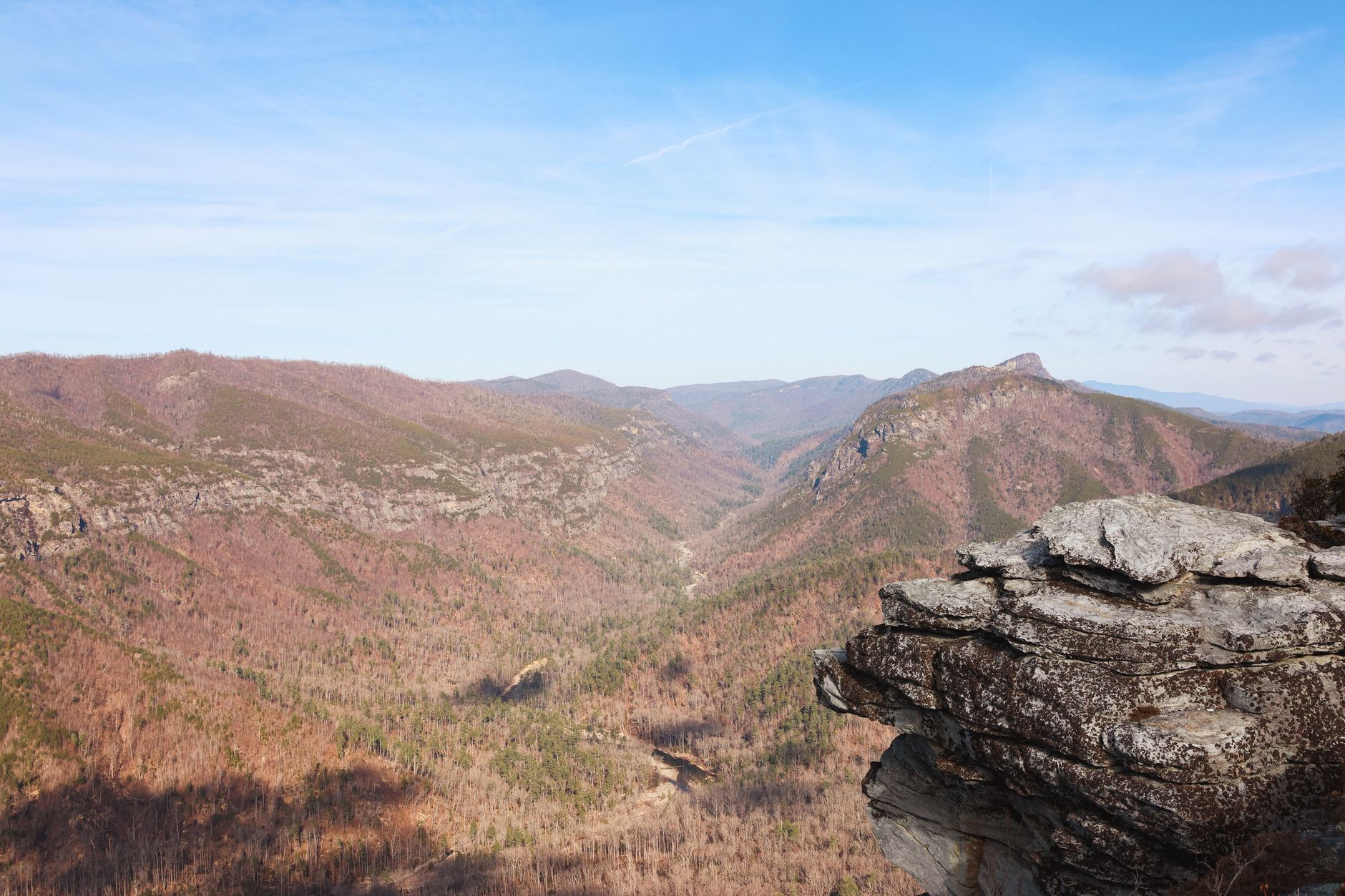
A short drive on, Bryson City is a small, easygoing town on the Tuckasegee River and the launch point for the Nantahala Gorge. The Great Smoky Mountains Railroad runs a scenic excursion through the gorge, and the dam-released Nantahala draws rafters and kayakers all season. On the park's edge, Deep Creek is a quieter entrance with an easy three-waterfall loop and some of the best tubing in the Smokies, easily filling a second day.
From Bryson City it is around 75 miles back to Knoxville on I-40 through the Pigeon River Gorge, closing the loop. If you have an afternoon to spare, Pigeon Forge and Dollywood sit right on the way.
October is the headline month, when fall colour peaks and the park is at its most spectacular and its busiest. Colour starts on the highest ridges in late September and works downhill over several weeks. Visit midweek to dodge the worst of the weekend traffic at Cades Cove and Kuwohi.
Spring (April into May) brings one of the richest wildflower displays in the eastern United States and thinner crowds. Summer is green and warm, with afternoon storms and the park's peak family season. Winter is quiet and often beautiful, but the high roads to Kuwohi and along Roaring Fork are closed.
Parking tag: Required parkwide. 5 USD per day, 15 USD per week, 40 USD per year. There is no separate entrance fee.
Beat the crowds: Start Cades Cove and Kuwohi early. Most day visitors arrive between 10 AM and 6 PM.
Seasonal roads: Kuwohi Road, Roaring Fork, and several secondary roads close in winter. Newfound Gap Road (US-441) stays open year-round, weather permitting.
Wildlife: Keep at least 50 yards from elk and bear. Never feed wildlife.
Fuel and signal: Fill up in the gateway towns. Cell coverage is patchy inside the park, so download offline maps before you set off.
A 10-day loop from Leeds through the Yorkshire Dales, Teesdale, UNESCO Durham and the chalk cliffs and gannet colonies of East Yorkshire: one of England's most varied driving circuits.
The full route — stops, maps, and driving times — is on Routebook by Kington.

A 8-day loop around Great Smoky Mountains National Park from Knoxville, taking in Cades Cove, the drive over Newfound Gap to Kuwohi, Cherokee's heritage, and the Nantahala Gorge.
 Routebookby Routebook


