

South Korea's volcanic island delivers lava tube caves, a UNESCO crater sunrise peak, a waterfall that falls straight into the sea, and a beach with genuinely turquoise water. Here is how to drive it in seven days.
Self-driving Jeju Island is one of the more rewarding road trips in Asia. South Korea's southernmost province is a volcanic island formed by ancient lava flows and shaped by the sea into an unlikely mix of crater peaks, cave systems, sea-spray waterfalls, and beaches with water a vivid shade of turquoise. This Jeju Island road trip itinerary covers the island in seven days, starting and ending at Jeju City Airport.
The island stretches 73 km east to west and 31 km north to south. It is compact enough to drive end to end in under two hours, but large enough that rushing defeats the purpose. Seven days is the right length for a first visit: long enough to hike Seongsan before the crowds arrive, linger at Hyeopjae Beach in the morning, and walk the Olle Trail without watching the clock.
Rental cars are the only realistic way to reach most of what makes Jeju worth visiting. Public buses serve the main towns but not the smaller coastal sites and walking trails. Most rental companies have desks at Jeju International Airport. Book ahead during Korean national holidays and in July and August, when demand peaks.
Roads are in good condition and signposted in Korean and English. An international driving permit is required for non-Korean licence holders. Traffic is manageable outside of summer weekends and public holidays.
The loop runs clockwise from Jeju City. It heads east to Seongsan Ilchulbong and the lava cave coast, south to Seogwipo and the waterfall and basalt column scenery, then northwest to Hallim and Hyeopjae Beach before returning to the capital.
Jeju City is a working Korean city rather than a resort town, and it is better for it. Two things are worth your time above the rest. The basalt rock formations at Yongduam Rock (Dragon Head Rock) are best seen in the late afternoon when the light catches the lava columns rising from the sea. Dongmun Traditional Market, a short walk from the waterfront, gives the clearest sense of what the island actually eats: black pork (heuk dwaeji), Hallabong tangerines, dried abalone, citrus confections, and green tea products.
Collect your rental car at the airport on arrival. Most agencies have desks in the terminal building. If you have an afternoon flight in, Hamdeok Beach, a pleasant black-sand and lava-rock beach 20 minutes east of the city, is a useful first stop to orientate yourself before settling in.
A 10-day southern France loop: Marseille's Calanques, Arles' Roman ruins and the Camargue, Saint-Tropez's beaches, and three nights on the French Riviera at Nice.
From Jeju City, ferries run to Udo Island, a small outlying island with unusual white-shell sand beaches. The ferry from Seongsan pier, which you pass on Days 3 and 4, is the more common option. Take it as a half-day trip on your second day around Seongsan if weather allows.
Seongsan Ilchulbong is the image most people already carry of Jeju before they visit. The volcanic crater cone erupted underwater about 100,000 years ago and now rises 180m from the sea, its rim covered in green grass. The hike to the rim takes about 20 minutes. Arrive before 8am to beat the tour groups and see the best morning light over the coast.
The rest of Day 3 works well at Seopjikoji, a flat volcanic headland a short drive south, where windswept grass and open sea views make for an easy afternoon walk. Woljeongri Beach nearby is lined with cafes and punctuated by black volcanic rock outcrops. It is a good stop for lunch.
Day 4 belongs to Manjanggul Lava Tube, a UNESCO World Heritage site about 20 km west of Seongsan. The tube runs 7.4 km in total; the 1 km section open to visitors is enough to understand the scale. Inside, basalt pillars lead to an extraordinary lava column at the far end, one of the world's largest known formations of its kind. The temperature inside holds at around 11 to 13 degrees Celsius year-round, so bring a light layer regardless of the season outside.
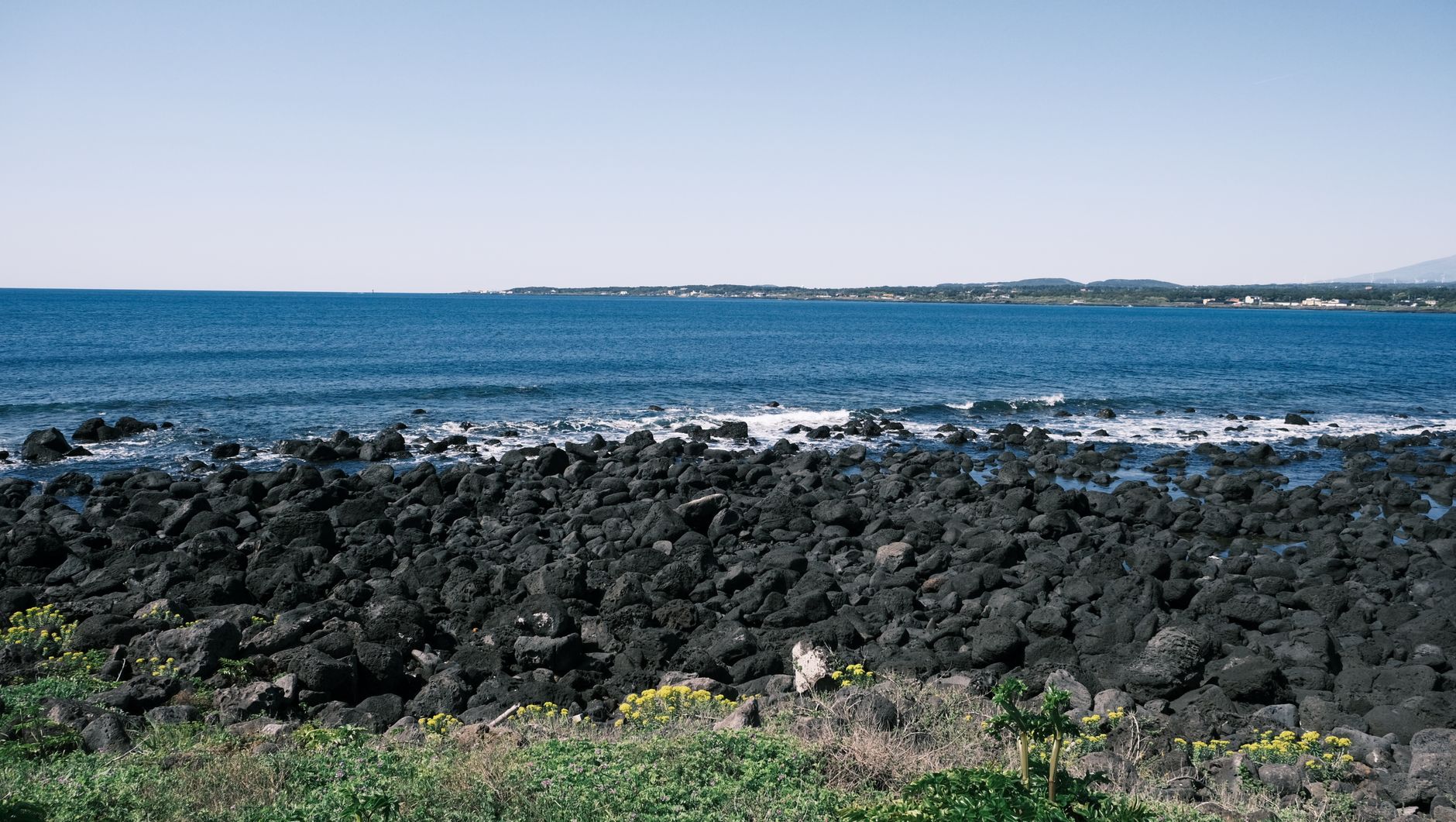
Seogwipo is Jeju's second city and the best base on the south coast. Three natural sites sit within easy reach and should not be skipped. Jeongbang Waterfall, a 23m cascade that falls directly into the sea, is one of a kind in Asia. Cheonjiyeon Falls, a few minutes' walk away, drops into a pool fringed by subtropical vegetation. The Jusangjeolli Basalt Columns, hexagonal lava pillars rising from the shoreline west of the city, are one of Jeju's defining geological features.
The Olle Trail network runs along Jeju's coastline in numbered sections. Route 6, which follows the Seogwipo cliffs, links several of these sites in a half-day walk and is one of the finest sections on the island. Download the free Jeju Olle Trail app for GPS waypoints before setting out.
Seogwipo is also the island's best base for eating well. The Seogwipo Maeil Olle Market has a more local character than Dongmun and is a good place to try grilled black pork, bindaetteok (mung bean pancakes), and fresh-pressed Hallabong tangerine juice.
The final full day heads to the west coast. Hyeopjae Beach is the island's most striking stretch of sand. The water runs a clear turquoise unusual for this latitude and fine white sand is backed by a forest of lava pines. Arrive in the morning for the best light and to beat the day-trip coaches from Jeju City.
Hallim Park, a five-minute drive north, combines subtropical botanical gardens with two accessible lava tube caves: Hyeopjae Cave and Ssangyong Cave. They are shorter and more accessible than Manjanggul, but well worth the visit if lava geology has caught your interest during the week.
The drive back to Jeju City from Hallim takes under an hour, closing the loop. Dongmun Market is worth a final visit for edible souvenirs before heading to the airport. Dried seafood, Hallabong citrus confections, and black sesame products all travel well.
Spring (April to June) and autumn (September to November) are the most rewarding seasons. Spring brings cherry blossoms and yellow canola flower fields across the countryside, with temperatures between 12 and 21 degrees Celsius and lower hotel prices than summer. Autumn is Jeju's finest season for hiking: clear skies, comfortable temperatures, and the red and gold foliage on Hallasan's higher slopes in October.
Summer (July to August) is the most visited time, with warmer sea temperatures suited to beach swimming, but brings peak crowds, higher hotel prices, and the risk of typhoons that can disrupt ferries and outdoor plans.
Winter (December to February) is quiet and inexpensive, with occasional snowfall on Hallasan and very few visitors at the island's natural sites.
Jeju International Airport has frequent connections from Seoul Gimpo (around 55 minutes), Busan, and Incheon. Several direct international services operate from Chinese and Japanese cities. Ferry services run from Mokpo on the mainland coast and take around five hours, and they are the main option for travellers bringing their own vehicle.
An international driving permit is required for non-Korean licence holders. Car hire agencies at Jeju Airport accept most major credit cards. Petrol stations are plentiful across the island. Most attraction signage is in Korean and English. A translation app covers anything else.
A 10-day loop from Leeds through the Yorkshire Dales, Teesdale, UNESCO Durham and the chalk cliffs and gannet colonies of East Yorkshire: one of England's most varied driving circuits.
The full route — stops, maps, and driving times — is on Routebook by Kington.

A seven-day clockwise loop of South Korea's volcanic island, linking a UNESCO crater sunrise peak, lava tube caves, sea-spray waterfalls, and the island's finest turquoise beach.
 Routebookby Routebook


