

Two of England's finest historic towns, a cathedral that was once the world's tallest building and a reservoir in its smallest county: this 6-day limestone road trip through the East Midlands covers some of England's most rewarding and least-visited countryside.
Most people drive straight through the East Midlands on the A1. That is a significant mistake. The stretch of England between Lincoln and Stamford contains two of the finest historic towns in the country, one of its grandest Elizabethan mansions, the world's most unusual church-in-a-reservoir, and a cathedral that was the tallest building on earth for over two centuries. This Lincoln Stamford Rutland road trip itinerary ties them into a 6-day loop that also includes Rutland, England's smallest county, and the rolling chalk hills of the Lincolnshire Wolds.
Route: Lincoln, Stamford (with a Rutland Water day trip), Grantham en route, Louth, returning to Lincoln
Duration: 6 days / 5 nights
Total driving: approximately 270 km
Best time: April to October for the fullest access to house and garden openings
The route is characterised by wide, flat skies and quiet country roads. There are no dramatic mountain passes or congested coastal strips. The reward is a sense of space that is rare in southern England, combined with a density of heritage that surprises almost everyone who takes the time to look.
The loop begins in Lincoln, a city that occupies one of the most dramatic sites of any in England. The Norman cathedral and castle both stand on the edge of a limestone ridge that drops sharply to the River Witham below, with the old city clustering on the slope between them and the modern city spreading across the flat ground at the foot of the hill.
Lincoln Cathedral was begun by the Normans in 1072 and extended repeatedly through the medieval period. The original spire, which collapsed in a storm in 1549, made the building the tallest in the world for over 200 years: its height of around 160 metres eclipsed the Great Pyramid of Giza by a significant margin. The present towers are considerably shorter but still dominate the city from every direction. Inside, the Angel Choir and the Lincoln Angel (a carved figure in the north transept) are among the most celebrated pieces of medieval sculpture in England.
Lincoln Castle, on the same ridge a few minutes' walk west, holds one of only four original copies of Magna Carta, signed by King John in 1215. It is displayed in a dedicated vault alongside a Forest Charter that is arguably just as historically significant.
Below the ridge, the cobbled street of Steep Hill connects the cathedral quarter to the modern city centre and is lined with bookshops, galleries and independent cafes that make slow progress inevitable. Bailgate at the top is the most characterful pedestrian area, with Newport Arch (the only Roman gateway in Britain still open to traffic) at its north end. Two nights are enough time to cover the main sights and take a walk along the Brayford Pool waterfront.
A 10-day southern France loop: Marseille's Calanques, Arles' Roman ruins and the Camargue, Saint-Tropez's beaches, and three nights on the French Riviera at Nice.
The drive south from Lincoln on the A15 takes around 70 minutes and brings you into a completely different landscape: the road drops from the Lincolnshire Edge into the valley of the River Welland, and suddenly the roadside buildings shift from red brick to the warm honey-coloured limestone that gives Stamford its character.

Stamford was designated England's first conservation area in 1967, and with good reason. Over 600 listed buildings cluster within easy walking distance of the town centre, and almost all of them are built from the same local Jurassic limestone that has given the town its identity since the medieval period. Sir Walter Scott called it the finest stone town in Britain, and it is hard to argue.
The five medieval churches include St Mary's (on the hill above the river), St Martin's (which contains the tomb of William Cecil, Lord Burghley) and St George's (a former headquarters of the Order of the Garter). The River Welland flows through water meadows at the heart of the town, and the Friday market brings over 90 stalls to the historic streets.
Burghley House sits just beyond the south edge of the town, across the Capability Brown parkland that stretches from the garden walls of St Martin's. Built between 1555 and 1587 by William Cecil, Lord Treasurer and chief minister to Elizabeth I, it is one of England's grandest Elizabethan buildings. The 18 State Rooms contain an exceptional collection of paintings and decorative arts, and the house hosts the Burghley Horse Trials each September, one of the world's premier three-day eventing events. It is a 20-minute walk from the town centre through the parkland, or a few minutes by car. Two nights in Stamford leave time for the town and Burghley on the first day and a day trip into Rutland on the second.
A 20-minute drive west of Stamford brings you into England's smallest county. Rutland was briefly merged with Leicestershire in 1974 and was so determined to regain its status that it successfully lobbied for reinstatement as an independent county in 1997, making it the only county to have been abolished and reinstated in modern British history.
The centrepiece is Rutland Water, a reservoir created in 1975 by flooding the Gwash valley. By surface area it is the largest reservoir in England: 3,100 acres of water with a 23-mile perimeter trail that is one of the finest cycling and walking circuits in the East Midlands. Bikes can be hired at two points around the reservoir.
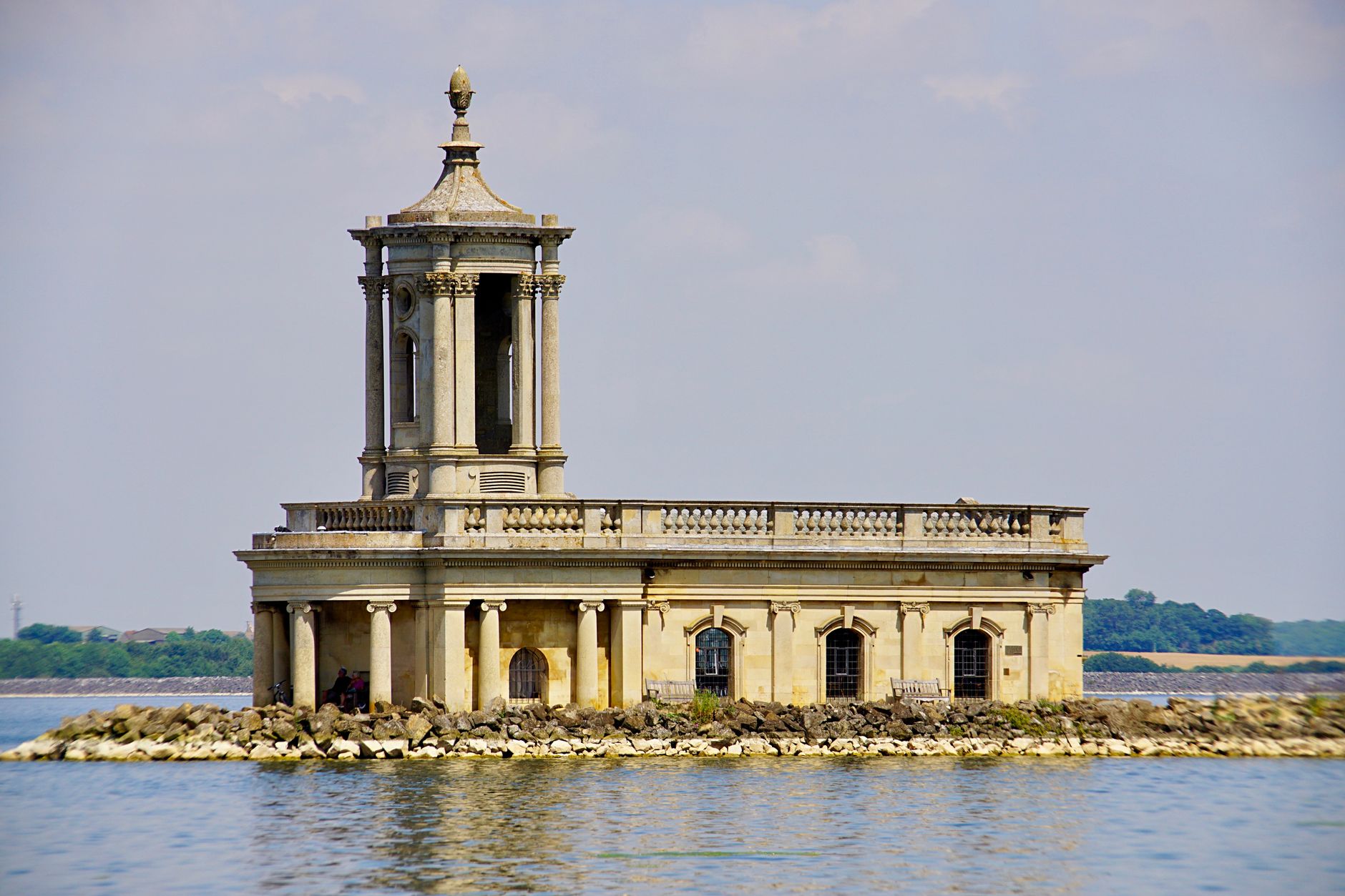
The most photographed feature of Rutland Water is Normanton Church, an 18th-century Classical building that was saved from demolition when the valley was flooded by raising its floor level and sealing the foundations. It now stands on its own causeway in the western arm of the reservoir, a genuinely strange and beautiful sight. The Rutland Belle boat cruise (45 minutes, departing from Whitwell Harbour) gives the best view of the church from the water.
Ospreys were reintroduced to Rutland in the late 1990s as part of a groundbreaking conservation project, and the viewing hides near Manton Bay and Lyndon give close views from spring through to late summer. Oakham Castle, in the town centre, is a remarkable survival: a 12th-century great hall with a collection of over 200 horseshoes donated by visiting royalty and peers, a local tradition dating back centuries.
On the drive north from Stamford towards the Wolds, Grantham makes an ideal stop on the A1 corridor and is often passed through rather than stopped in. It rewards a break. The town's most significant heritage asset is Belton House, 3 km north: a Restoration-period country house built in 1685 that the National Trust considers the finest surviving example of its era. The formal gardens, orangery and 1,300-acre estate are open from April to October.
For science history, Woolsthorpe Manor (National Trust, 8 km south of Grantham near Colsterworth) is where Isaac Newton was born in 1643 and where he spent 18 months during the Cambridge plague closure of 1665 and 1666, during which he developed his theories of gravity, motion and colour. The apple tree in the garden is almost certainly a descendant of the tree under which the famous incident supposedly occurred. The manor has limited opening hours; check ahead.
Back in the town, the Angel and Royal Hotel on the High Street is one of England's oldest surviving coaching inns, with documented use since at least 1203. It is worth a look at the stone facade even if you are not staying.
The drive northeast from Grantham to Louth (around 90 minutes via the A17 and A157) is the longest leg of the route and the most scenic. The road crosses the flat Lincolnshire Fenland before climbing into the chalk hills of the Lincolnshire Wolds, one of England's least-known Areas of Outstanding Natural Beauty. The landscape opens into wide rolling farmland with hedgerow-edged lanes, views to the Humber Estuary in the far distance and a sense of space that is increasingly rare in southern England.
Louth is described as the Capital of the Wolds, and as a market town it earns the title. The medieval street plan survives intact, lined with independent shops, award-winning food businesses and Georgian buildings that reflect the town's prosperity in the coaching era. Wednesday, Friday and Saturday markets still trade on the same cobbled spots where they have operated for centuries.
The unmistakable centrepiece is St James' Church, whose Perpendicular Gothic spire was completed in 1515. At 89 metres, it is the tallest medieval parish church spire in Britain. Simon Jenkins placed it in his list of England's thousand best churches, calling it the most perfect Perpendicular Gothic steeple in England. Tower climbs (198 steps) run on selected summer dates; the views on a clear day reach the Humber Estuary to the north and Lincoln Cathedral to the west.
Hubbard's Hills, a steep-sided chalk valley on the edge of the town, is a free and much-loved local walking spot that showcases the Wolds character at its best.
The return west from Louth on the A157 takes around 40 minutes via Market Rasen, passing through the heart of the Wolds before the landscape flattens into the Lincolnshire plain and Lincoln Cathedral reappears on the horizon. A final morning in the city is best spent on the Brayford Pool waterfront or at the Museum of Lincolnshire Life before heading home.
Best time: April to October for the fullest access to house openings (Belton House, Woolsthorpe Manor, and Burghley House all have seasonal hours). Lincoln and Stamford are good destinations in winter too: cathedral evensong services and Christmas markets are a worthwhile draw from November to December.
Accommodation: Stamford has the best range of characterful places to stay, including several limestone coaching-inn conversions. Lincoln has plenty of hotels within walking distance of the cathedral quarter. Louth is quieter, with B&B accommodation that is easier to book than the larger stops.
National Trust: Both Belton House and Woolsthorpe Manor are National Trust properties. NT members get free entry. If you are not a member, a single day's entry to Belton House roughly equals the cost of a year's NT membership for one adult: worth considering if you visit other properties regularly.
Driving: The Lincolnshire roads are generally quiet and well-maintained. The A1 is the fastest north-south corridor but the A15 (Lincoln to Stamford) and the A157 (Louth to Market Rasen) give a much better sense of the landscape. Allow extra time on market days in Stamford (Friday) and Louth (Wednesday, Friday, Saturday) when parking fills quickly.
Budget: This is a mid-range trip. Burghley House is the main paid attraction (around £20 per adult online). Rutland Water bike hire and the Rutland Belle cruise add to costs at Oakham. Lincoln Cathedral has a suggested entry donation. Most other sights are free or very low cost.
A 10-day loop from Leeds through the Yorkshire Dales, Teesdale, UNESCO Durham and the chalk cliffs and gannet colonies of East Yorkshire: one of England's most varied driving circuits.
The full route — stops, maps, and driving times — is on Routebook by Kington.

Two of England's finest historic towns, one of its greatest Elizabethan mansions and its smallest county: this 6-day loop from Lincoln through Stamford, Rutland Water and the Lincolnshire Wolds passes through a landscape of medieval spires, Jurassic limestone and wide East Midlands skies.
 Routebookby Routebook

