

A 9-day loop from Bari takes in UNESCO trulli, the White City of Ostuni, extravagant baroque Lecce and the crystal waters of the Salento coast — with no single drive longer than 3 hours.
If you are planning a Puglia road trip itinerary that covers the region's greatest hits without feeling rushed, this 9-day loop from Bari delivers. You will drive through the trulli villages of the Valle d'Itria, climb the whitewashed hillside of Ostuni, reach the easternmost tip of Italy at Otranto, walk the extravagant baroque streets of Lecce, and finish on the Ionian coast at Gallipoli before the short drive north to Bari.
Total driving across the whole loop is under eight hours, and no single leg is longer than three hours. That leaves plenty of time for the things that matter: lingering over orecchiette and Primitivo wine, swimming in clear Adriatic coves and getting lost in medieval alleyways that have changed little in 500 years.
This itinerary works best from late May to early June or in September, when temperatures are warm, the sea is swimmable and the summer peak crowds have not yet descended.
Car: Rent the smallest available, ideally a Fiat Panda or similar. Puglia's historic centres have narrow streets, tight parking and ZTL (limited traffic) zones monitored by cameras. A small car saves stress.
Tolls: The A14 autostrada runs down the Adriatic coast and carries modest tolls (roughly €8 for the Bari to Taranto section). Keep your ticket to exit. Smaller provincial roads are free.
ZTL zones: Lecce, Alberobello and Ostuni all have camera-monitored historic centres. Book accommodation inside these zones for an exemption permit, or park on the edge and walk.
Budget: A mid-range trip with comfortable accommodation and good restaurants runs around €130 to €170 per person per day, excluding flights. Puglia remains better value than Amalfi or Cinque Terre.
Fly into Bari Karol Wojtyla Airport, collect your hire car and drive the eight kilometres into the city. Bari Vecchia, the medieval old town, rewards a couple of hours of aimless wandering. The Basilica di San Nicola (an 11th-century pilgrimage church), the Romanesque cathedral and the harbour front are all close together.
Park outside the ZTL zone and walk in. The Lungomare promenade is good for an early evening stroll before dinner.
Thirty minutes south of Bari, Polignano a Mare is one of those places that genuinely lives up to its photographs. The medieval village clings to white limestone cliffs that drop straight into a green-blue sea. Walk the boardwalk above Cala Porto, take in the Terrazza Santo Stefano viewpoint, and swim at Lama Monachile beach if the season allows.
A 10-day southern France loop: Marseille's Calanques, Arles' Roman ruins and the Camargue, Saint-Tropez's beaches, and three nights on the French Riviera at Nice.
Arrive early. The coach tours fill the alleys from 10am; if you get there at 8 or 9, you will have the clifftop largely to yourself. Push on to Alberobello after a mid-morning swim.
Drive time to Alberobello: around 30 minutes.
Alberobello is unlike anywhere else in Europe. Over 1,500 trulli cover the hillside of the Rione Monti quarter: dry-stone dwellings with conical limestone roofs and whitewashed walls, built without mortar. UNESCO inscribed the town in 1996.
The peak crowds (10am to 4pm) can make the main souvenir strip feel overwhelming. Arrive before 10am or plan to visit in the evening after 6pm when the day-trip buses have left. The quieter lanes to the side of the main street, and the view across the rooftops at sunset, are the best the town offers.
The drive here from Polignano passes through the Valle d'Itria. Pull off the SS172 to photograph isolated trulli scattered across the olive-grove landscape.
Drive time to Ostuni: around 1 hour 15 minutes.
Ostuni's whitewashed streets and hilltop Gothic cathedral are visible from the coastal plain long before you arrive. The historic centre rewards a couple of hours on foot: walk up through the medieval quarter to the cathedral terrace for views over olive groves and out to the Adriatic.
Ostuni is lively but less overrun than Alberobello. Good restaurants fill the old quarter and there is a relaxed aperitivo culture in the main piazza. If September harvest festivals are running, try to coincide.
Drive time to Otranto: around 1 hour 15 minutes.
Otranto marks the tip of the Italian heel, the easternmost point in Italy, with Albania visible across the strait on a clear day. The 12th-century cathedral's floor mosaic is the main attraction: a complete cosmological map rendered in stone across the entire nave, dating to 1163 and free to visit outside Mass times.
The Aragonese Castle ramparts overlook the harbour. The beaches north and south of town have some of the most translucent Adriatic water on the whole route. Use Otranto as a base for an afternoon swim before the short drive to Lecce.
Drive time to Lecce: around 42 minutes.
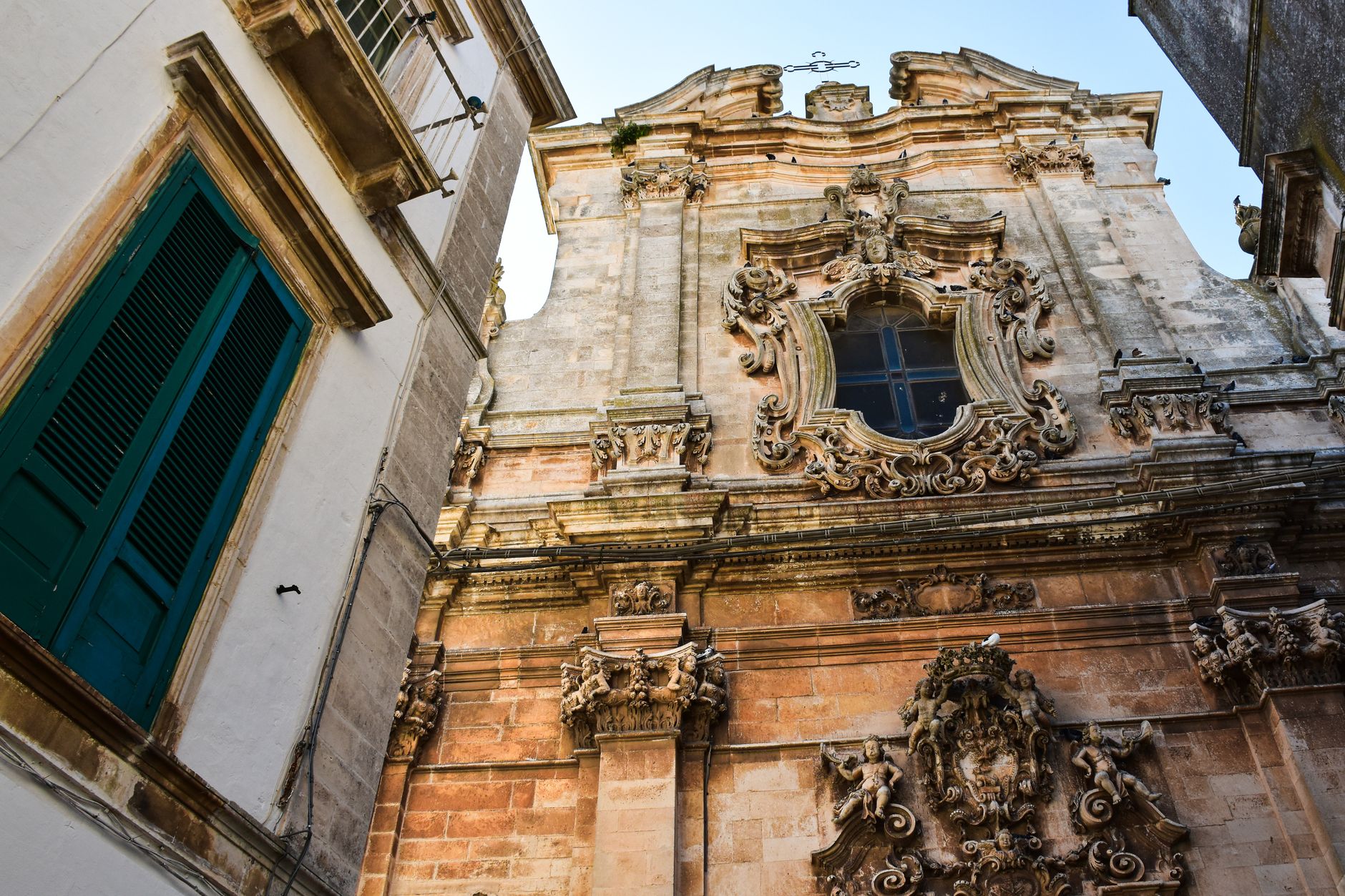
Two nights in Lecce is the right call for the most extravagant baroque city in Italy. The Basilica di Santa Croce took nearly 150 years to complete; tier on tier of fantastical carved stone covers the facade. Piazza del Duomo adjoins it, enclosed on three sides and theatrical in a way few Italian piazzas manage.
Beyond the set pieces, Lecce rewards aimless walking. The old centre is largely pedestrianised, the local pietra leccese stone glows golden in the afternoon sun and the café and restaurant scene is excellent. The Roman amphitheatre sits in the main piazza, partly excavated beneath the pavement.
Lecce's restaurants specialise in Salento cooking: fresh pasta, excellent vegetables, good local wine. Sit outside in the evening and leave no earlier than 10pm.
Gallipoli's medieval old town sits on a small island connected to the mainland by a 16th-century causeway. The view from the castle over the Ionian Sea is one of the best moments on the route. Walk across, have lunch in the old town, try the fried street food sold from the old town walls, and explore the harbourside alleys.
The Baia Verde beach clubs south of town are popular in season; book in advance in August.
Drive time to Bari (Day 9): around 2 hours 30 minutes on the E90.
The loop closes with the drive north on the E90. If your flight allows, the morning fish market near Bari's old port is worth a quick stop before returning the hire car to the airport.
This route works as a loop starting and ending at Bari Karol Wojtyla Airport, so there is no need to position a hire car at a different location. Total distance is around 446 km, making it compact by road trip standards.
A 7-night version (removing Lecce's second night) is feasible if time is tight, but the 8-night version above gives the right balance of driving and exploring. If you want to extend, a second night in Otranto using the town as a beach base for the Salento coast is the easiest addition.
Food to look for on the road: orecchiette con cime di rapa, burrata, frisella with cherry tomatoes and olive oil, Primitivo di Manduria red wine, grilled fish on the coast, and Gallipoli's fried snacks.
Puglia delivers a lot of Italy in a small area. Rent the smallest car, eat lunch as the main meal and resist the urge to rush — the distances are short enough that there is no reason to.
A 10-day loop from Leeds through the Yorkshire Dales, Teesdale, UNESCO Durham and the chalk cliffs and gannet colonies of East Yorkshire: one of England's most varied driving circuits.
The full route — stops, maps, and driving times — is on Routebook by Kington.

Drive Puglia's heel in 9 days: trulli villages, the White City of Ostuni, Lecce's baroque extravagance and the crystalline Adriatic and Ionian coasts.
 Routebookby Routebook


