

From the medieval splendour of Wells Cathedral to the mystical Glastonbury Tor, artisan Frome and the drama of Cheddar Gorge, this seven-day Somerset loop is compact, rich in history and deeply rewarding.
Somerset is often overlooked in favour of its more celebrated neighbours, but this small county contains some of England's most distinctive landscapes and best-preserved historic towns. This Somerset road trip itinerary links four of the county's most rewarding destinations in a circuit that never requires more than 45 minutes of driving between stops.
All four (Wells, Glastonbury, Frome, and Cheddar) stand on their own merits. Combined, they give a complete picture of why this part of England remains so quietly outstanding.
Somerset lacks the fame of the Cotswolds or the coast of Cornwall, which means it tends to receive the visitors it deserves rather than the summer hordes. Wells, Glastonbury and Cheddar are all genuinely world-class sites in their categories: the finest Gothic cathedral in the west of England, an iconic hill with one of the most dramatic views in the country, and Britain's deepest gorge. Frome has meanwhile become one of England's most interesting small towns with minimal fanfare.
All four stops are within 25 miles of each other, making this one of the most compact quality road trips in England.
The loop runs anticlockwise from Wells: six miles south to Glastonbury, 16 miles east to Frome, 22 miles northwest to Cheddar, then 8 miles back east to Wells. Two nights in Wells at the start and two nights in Cheddar at the end give each main stop its proper time.
England's smallest city is built entirely around its cathedral. Wells Cathedral, begun around 1175 and completed by 1490, was England's first wholly Gothic building and remains one of the most satisfying in the country. The west front is the most photographed view: a screen of medieval sculpture holding over 300 statues, described as the largest collection of medieval sculpture in the world. Inside, the scissor arches built in the 1340s to support the crossing tower are the cathedral's visual signature. The astronomical clock from around 1390, showing the phases of the moon and the position of the sun, is still keeping time.
Beyond the cathedral close, the Bishop's Palace and its moat are open to visitors. Swans have rung the gatehouse bell at feeding time since the 1840s, a local legend that turns out to be true. Vicars' Close, a short walk from the cathedral's west door, is the only complete medieval street surviving in Europe: 42 small houses built in the 1340s for the cathedral's singing clergy, intact and still occupied today.
Two nights in Wells gives enough time for the cathedral with a proper look at everything, the Bishop's Palace, and an evening walk along the moat.
Park at the multi-storey on Princes Road. Cathedral entry is £8; free evening evensong is worth attending if the timing works. The city is small enough to walk everywhere.
A 10-day southern France loop: Marseille's Calanques, Arles' Roman ruins and the Camargue, Saint-Tropez's beaches, and three nights on the French Riviera at Nice.

Glastonbury is six miles south of Wells on the edge of the Somerset Levels. The Tor is impossible to miss: a solitary hill rising to 158 metres with the ruined tower of St Michael's church on its summit. The 20-minute walk from the National Trust car park on Wellhouse Lane rewards with views extending across Somerset, Wiltshire, and on clear days into Wales. The Levels below, when flooded in winter, give the Tor its island quality that fed the Arthurian legends of Avalon.
Glastonbury Abbey, in the town centre, is the ruin of what was once one of England's wealthiest monasteries. Founded in the 7th century, it was destroyed in the Dissolution of the Monasteries in 1539. The extensive grounds contain the remains of the Lady Chapel and the Great Church, and a museum displays medieval artefacts recovered from the site. The association with King Arthur's legendary burial has drawn pilgrims and visitors for over a millennium.
The town itself rewards a few hours. The High Street has a concentrated selection of independent shops, crystal and herb dealers, good cafes, and places that are unlike anything in the rest of England. It is worth an afternoon even if the mystical side of things is not your particular interest.
Practical: The Tor is free to access; a small charge applies for the car park. Book Abbey entry online. The annual music festival takes place on a farm on the southern edge of the town in late June.
Frome (the name is pronounced to rhyme with 'room') is 16 miles east of Glastonbury. The drive crosses the northern Mendips on minor roads through Shepton Mallet, which has a good market square if time allows a stop.
Frome is Somerset's most self-consciously independent market town, Georgian in its architecture and fiercely itself in character. Cheap Street, the steep medieval main thoroughfare, has kept nearly all its 17th-century shop fronts and a stream running down the centre of the street in an open conduit. A first-Sunday independent market fills the town centre on the first Sunday of each month with local food producers, makers, and artists and draws visitors from Bristol, Bath and beyond. Even outside market weekends, the town has a strong independent food and arts scene.
One night is enough to get the full measure of Frome. The drive to Cheddar the next morning is under an hour.
Practical: Park at Merchant Barton car park. If visiting on the first Sunday, arrive by 10am for the best of the market. Accommodation books up on market weekends.
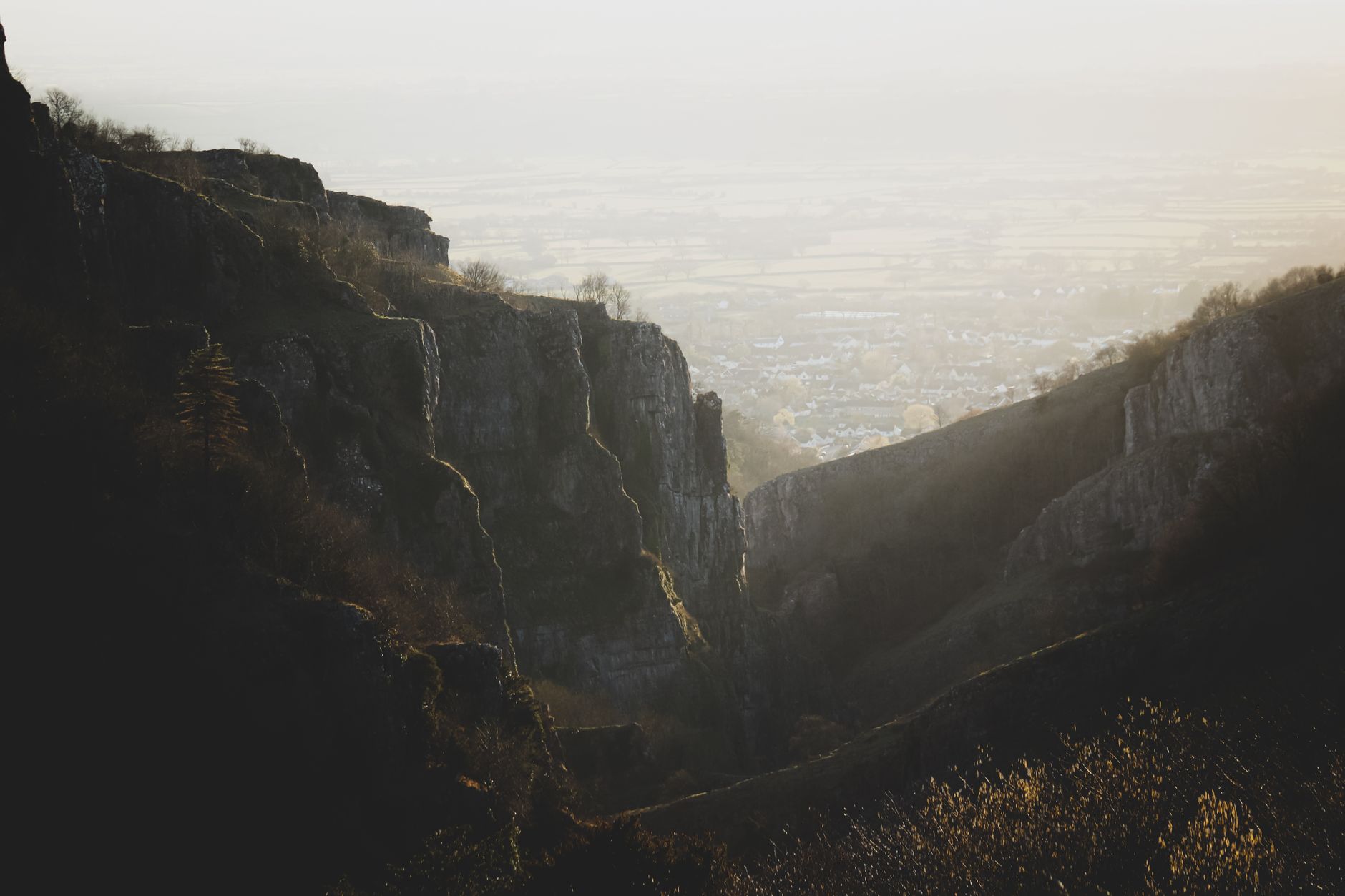
The 22-mile drive from Frome to Cheddar crosses the northern edge of the Mendips on the A361 before descending into the gorge from above, which gives the best introduction to the landscape. Cheddar Gorge is Britain's deepest gorge: the B3135 road winds 3 km through limestone cliffs that rise up to 137 metres on both sides of the road.
The Cheddar Caves are the main paid attraction at the base of the gorge. Gough's Cave runs 115 metres into the hillside and holds the exhibits centred on Cheddar Man, whose 9,000-year-old skeleton was found here in 1903. It is the oldest complete human skeleton in Britain and the museum displays include a DNA-based reconstruction of how he likely looked. Cox's Cave, shorter and more intimate, has the best stalactite formations. Allow a full day for both caves and the clifftop walk.
The second day at Cheddar is best spent on the landscape rather than the caves. The cliff-top paths give views down into the gorge and across the Levels. Jacob's Ladder, 274 steps carved into the cliff face, provides the steepest direct ascent. The village of Cheddar has the usual tourist shops and the original dairy that produces the cheese the world named after it.
Practical: Book cave tickets online in advance. The gorge road is a single carriageway and can be very congested on summer weekends; arrive before 9am or after 4pm.
The 8-mile drive from Cheddar back to Wells takes 20 minutes on the A371. If there is time, Wookey Hole is four miles north of Wells and has a show cave with guided tours through chambers carved by the River Axe, a different experience to the Cheddar caves. The drive back into Wells gives a final view of the cathedral tower over the rooftops of the surrounding streets.
Getting there: Wells has no railway station. The nearest main-line station is Castle Cary, six miles to the south, with direct trains to London Paddington in under two hours. Bristol Airport is 20 miles north; Bristol Temple Meads station is 20 miles and has regular direct buses to Wells.
Driving: Somerset's roads are largely single carriageway with low speed limits through the small towns. The Cheddar Gorge road in particular requires patience in peak summer. A small car makes navigating the narrow lanes significantly easier.
Where to stay: Wells has several good B&Bs and small hotels within walking distance of the cathedral. In Cheddar, accommodation is more limited; a few B&Bs in the village or along the gorge road are the main options. Glastonbury and Frome each have a handful of characterful places.
Eating: Somerset produces good cider and cheese; both are worth seeking out from local producers. Glastonbury has the best independent cafe and restaurant scene of the four stops. Wells has a few good restaurants near the cathedral quarter.
May to October is the best window. May and June offer wildflowers on the Mendip Hills, the best light for photography at the Tor, and visitor numbers below the midsummer peak. September is particularly good: warm light, quieter roads, and apple orchards coming into fruit across the county. Avoid the Glastonbury Festival weekend in late June if you want the town at its most relaxed.
A 10-day loop from Leeds through the Yorkshire Dales, Teesdale, UNESCO Durham and the chalk cliffs and gannet colonies of East Yorkshire: one of England's most varied driving circuits.
The full route — stops, maps, and driving times — is on Routebook by Kington.

A 4-day walking or cycling tour through Somerset's ancient heart, staying overnight in Wells, Glastonbury and Cheddar, following the traffic-free Strawberry Line and the paths of the Somerset Levels and Mendip Hills.


