

Six days through the undiscovered heart of England: Lichfield's triple-spired cathedral, Cannock Chase's deer herds, the Potteries' Victorian bottle kilns, a steam railway through wooded gorges, and Burton's legendary brewing heritage.
Few English counties pack this much variety into so compact a space. Staffordshire sits at the geographic heart of England, ringed by motorways and within two hours of most major cities, yet it remains firmly off the mainstream road-trip circuit. This six-day loop changes that.
The itinerary moves clockwise from Lichfield through Cannock Chase to the Potteries, into the Churnet Valley, and back via Burton upon Trent: a 160-kilometre circuit linking England's only three-spired cathedral, a National Landscape of ancient heathland and deer, a World Craft City built on fine china, a steam railway through wooded gorges, and the town that gave the world industrial-scale brewing.
Best time to go: April to October gives the most reliable weather and the full range of seasonal attractions. The Churnet Valley Railway's dining trains run from spring through autumn. The Cannock Chase deer rut peaks in October, drawing photographers from across the country. Summer weekends at Gladstone Pottery and Wedgwood fill up quickly: book ahead. Outside these months, most attractions remain open but Churnet Valley trains run less frequently.
Getting there: Lichfield is 16 miles north of Birmingham and reachable from London in around 2.5 hours via the M1 and M6. Direct trains from Birmingham New Street take 24 minutes. The loop is best driven: public transport between the stops is limited, and the Churnet Valley and Cannock Chase are only fully accessible by car.
Budget: A mid-range six-day trip (B&Bs and local inns, pub lunches, main museum admissions) runs around £110 to £150 per person per day. Lichfield Cathedral and Cannock Chase trails are free or low-cost; Gladstone Pottery Museum and Trentham Estate add a modest admission each.

Lichfield's skyline is unmistakable. Three rose-red sandstone spires rising over a Georgian market city make England's only three-spired cathedral the county's defining landmark. Construction began in 1085 and the nave's soaring columns and carved chapter house were complete by the mid-14th century. Inside, the Herkenrode Glass fills an entire aisle with extraordinary 16th-century Belgian stained glass, rescued from a Cistercian convent during the Napoleonic Wars and installed here in 1802.
Across the cathedral close, the Samuel Johnson Birthplace Museum occupies the house where the lexicographer was born in 1709. Johnson compiled the first comprehensive English dictionary, and the museum traces his life with warmth and detail. The Cathedral Close itself rewards an hour's walk, taking in the Bishop's Palace, deanery gardens, and medieval walls that survived two Civil War sieges.
A 10-day southern France loop: Marseille's Calanques, Arles' Roman ruins and the Camargue, Saint-Tropez's beaches, and three nights on the French Riviera at Nice.
On your second day, choose between two contrasting day trips from Lichfield. The National Memorial Arboretum at Alrewas, 12 miles south on the A38, opened in 2001, is Britain's year-round centre of remembrance: 330 memorials spread across 150 acres of arboretum, anchored by the Armed Forces Memorial and backed by riverside woodland walks.
Alternatively, head north-west into Cannock Chase, one of England's smallest National Landscapes at just 26 square miles, which rises dramatically from the surrounding lowlands on a sandstone ridge of ancient heathland, pine plantation, and open meadow.
Some 800 free-roaming fallow deer graze the Chase throughout the year. Early mornings along Sherbrook Valley road and the Marquis Drive are the most reliable viewing spots; the October rut fills the heathland with sound and draws photographers from across the country. The Go Ape high-ropes course at Birches Valley offers aerial adventures for families, and a network of waymarked mountain-bike trails covers every ability from family beginner to black-grade technical.
On the western edge of the Chase, the German War Cemetery at Broadhurst Green contains the graves of 4,883 German soldiers from both World Wars. Its rows of basalt lava crosses set beneath towering oaks provide a quietly moving experience, very different from the British memorial sites at the National Memorial Arboretum.
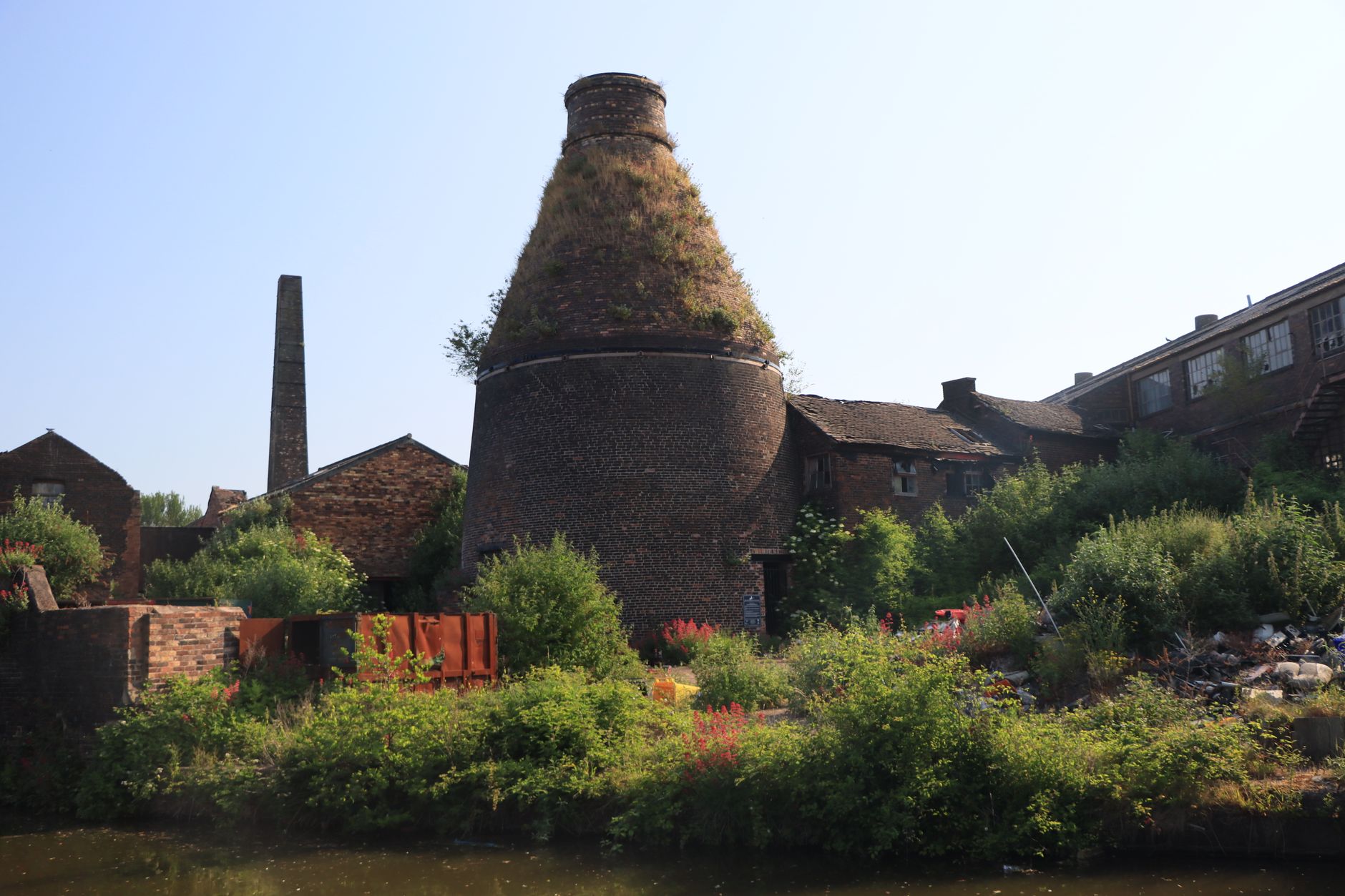
Awarded World Craft City status in 2024, the Potteries district is a living museum of ceramic heritage. Six merged towns produced the tableware of the British Empire: Wedgwood, Spode, Minton, and dozens of smaller names whose output furnished households across the globe.
Begin at Gladstone Pottery Museum in Longton, the world's last complete Victorian pottery factory. Intact bottle kilns, saggar-making rooms, and working throwing studios make this the most atmospheric stop on the route. The Great Pottery Throwdown has filmed here, but visitors are equally welcome to book a throwing session at any time.
Middleport Pottery, a mile north in Burslem, is another survivor: the only Victorian pot bank still in full commercial production, making Burleigh ware since 1888. Factory tours run most days, and the canal-side location on the Trent and Mersey Canal adds to the appeal.
The World of Wedgwood at Barlaston is the flagship. The V&A Wedgwood Collection includes the priceless Portland Vase copy, letters and pattern books from Josiah Wedgwood, and a working factory tour showing how fine bone china is still made today.
Set aside part of the second day for the Potteries Museum and Art Gallery in Hanley, which holds the world's largest collection of Staffordshire ceramics alongside an aircraft gallery featuring the only surviving Reginald Mitchell-designed Spitfire prototype.
On Stoke-on-Trent's southern edge, Trentham Estate provides a welcome contrast: 725 acres of Capability Brown parkland around a mile-long lake, with Italian gardens, a shopping village, and the UK's only walk-through colony of free-roaming Barbary macaques.
With two nights in the Potteries, set aside a day trip east into the Churnet Valley. Leek, the valley's gateway, is a compact market town with a strong arts-and-crafts tradition rooted in its silk-weaving past. The weekend antiques market and the Nicholson Institute's galleries are worth an hour, but the valley itself is the draw.
The Churnet Valley Railway runs preserved steam and diesel trains through what locals call 'Little Switzerland'. The valley narrows between steep wooded hillsides above the Churnet river and the old Caldon Canal; viaducts and station halts built for the 19th-century tourist trade survive intact. The railway links Cheddleton and Froghall, approximately 10 miles, with a station at Consall Forge accessible only by rail or on foot. Afternoon dining trains and seasonal Sunday lunches fill up fast.
Dimmingsdale, a National Trust woodland near Alton, offers excellent walking at any season: mossy paths lead past the ruins of the Ramblers Retreat teahouse to a chain of old millponds.
Brewing in Burton began when the Benedictine monks of Burton Abbey discovered that the town's well water had unusual properties. The high sulphate content, now known as the Burton Snatch, produced clearer, more bitter ales than any water elsewhere in England. By the 1880s, one third of all beer produced in Britain came from Burton.
The National Brewery Centre occupies what was once part of the Bass brewery complex and traces the industry from medieval monks to 20th-century consolidation. Working brewing exhibits, period delivery vehicles, and a complete Victorian cooperage line the main hall, with guided tastings completing the visit.
Before heading back to Lichfield, the village of Abbots Bromley is worth a short detour north of the A518. Best known for its annual Horn Dance (held every September, when sets of medieval deer antlers are paraded around the parish), it has a fine butter cross, a timber-framed inn, and a Saxon-founded church.
The return drive to Lichfield takes around 20 minutes, closing a loop that covers five distinct faces of one of England's most underrated counties.
Start your Staffordshire road trip itinerary in Lichfield and discover a county that rewards curiosity with generosity. The distances are short, the variety is exceptional, and the crowds are thin.
A 10-day loop from Leeds through the Yorkshire Dales, Teesdale, UNESCO Durham and the chalk cliffs and gannet colonies of East Yorkshire: one of England's most varied driving circuits.
The full route — stops, maps, and driving times — is on Routebook by Kington.

A six-day loop through the heart of England, linking Lichfield's triple-spired cathedral, the deer herds and ancient heathland of Cannock Chase, the Victorian bottle kilns and fine china workshops of the Potteries, the steam railway gorges of the Churnet Valley, and Burton upon Trent's legendary brewing heritage.

