

A 5-day, two-base Worcestershire loop from Worcester and Bewdley through the Malvern Hills, a steam railway, Teme Valley orchards and a Roman salt town: England's most underrated county, driven slowly.
Worcestershire rarely features on English road trip lists. Wedged between the Welsh border counties and the West Midlands, it is bypassed in favour of the Cotswolds to the south and the Peak District to the north. That anonymity is part of its appeal. This 5-day, two-base loop from Worcester and Bewdley covers 133 kilometres, threading through the Malvern Hills AONB, the Severn Valley, the remote Teme Valley orchards and a Roman salt town whose brine springs have been working since the first century AD. The driving is unhurried, though Worcestershire's winding lanes mean the longest leg is closer to an hour than the short distances suggest.
Worcester stands at the centre of the loop and is the most practical arrival point, with direct rail connections to Birmingham (30 minutes) and London Paddington (2 hours). From there the route drops south to the Malvern Hills before curving north through Bewdley and the Wyre Forest, crossing west into the Teme Valley at Tenbury Wells, then returning east through Droitwich Spa to Worcester. Nothing on this route exceeds an hour of driving between stops.
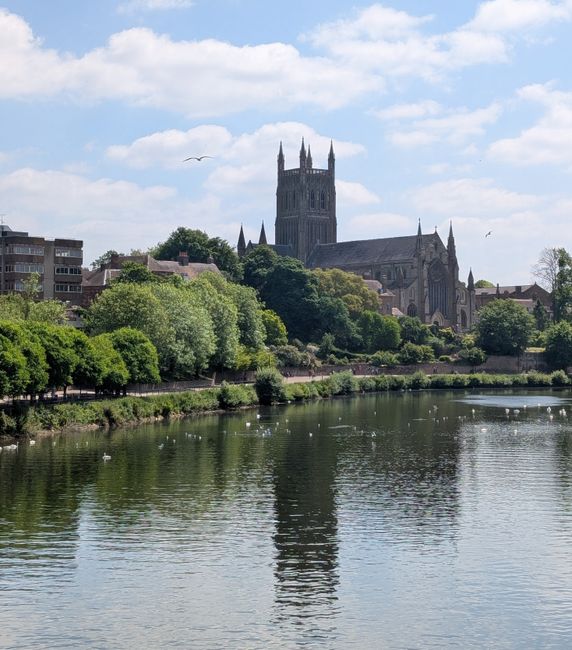
Worcester is a city that rewards walking from the railway station. You cross Foregate Street and find yourself, in three minutes, at the cathedral close looking south over the River Severn. The cathedral is one of the most important Norman and Gothic buildings in England. King John, who died in 1216, is buried at the high altar. Prince Arthur's Chantry Chapel, built by Henry VII in 1504 to commemorate his son who died aged 15, contains some of the finest carved stonework of the Tudor period. The Norman crypt, preserved since 1084, runs the full length of the nave below street level.
The rest of the city centre is compact and walkable. The Commandery, a 15th-century hospital that became Charles II's headquarters at the Battle of Worcester in 1651 (the final battle of the Civil War), is 10 minutes from the cathedral and one of the best interpretive sites of the period in England. The Worcester Porcelain Museum on Severn Street holds 300 years of Royal Worcester production, including the service made for King George III. The factory on Midland Road offers guided tours by arrangement.
Base in Worcester for the first half of the trip: time for the cathedral, the Commandery and the Porcelain Museum, plus a walk along the Severn riverside path towards the cricket ground, where county matches take place against a cathedral backdrop. Great Malvern and Droitwich Spa are both easy day-trips from the city.
A 10-day southern France loop: Marseille's Calanques, Arles' Roman ruins and the Camargue, Saint-Tropez's beaches, and three nights on the French Riviera at Nice.
Great Malvern is 13 kilometres south of Worcester on the A449. The town climbs the western foot of the Malvern Hills, a ridge of Precambrian rock that is among the oldest exposed geology in Britain, rising to 425 metres at Worcestershire Beacon. Victorian visitors came for the mineral springs; the water still flows from taps set into the hillside and is collected freely by residents and walkers.
The walk to Worcestershire Beacon from the Priory takes about an hour in good conditions. On a clear day the view extends east across the Severn Plain towards the Edge Hills and west to the Black Mountains of Wales. Fourteen counties are visible from the summit. The Priory itself has Norman pillars from 1085 and a set of medieval stained glass windows that the Victoria and Albert Museum considers second only to those at York Minster.
For Elgar's connection to the hills, the Elgar Birthplace Museum at Broadheath (3 miles north) preserves the thatched cottage where the composer was born in 1857, with the world's largest collection of Elgar manuscripts. The museum traces how the hills shaped his Enigma Variations (1899) and the Cello Concerto (1919).
Great Malvern is a short drive south of Worcester and makes an easy day out for the ridge walk and the Priory. Keen walkers who want the full 7-mile ridge circuit could give it most of a day.

Bewdley is about 45 minutes north of the Malverns, or half an hour from Worcester, and makes the natural second base for the northern half of the county. The town sits on a bend of the River Severn, and the Georgian street plan around Load Street remains largely intact from the 18th century, when Bewdley was one of the most important inland ports on the river. Thomas Telford's bridge of 1798 is worth photographing from the opposite bank.
The Severn Valley Railway departs from Bewdley station. The heritage line runs 16 miles south to Bridgnorth through riverside meadows and the Severn gorge; the full round trip takes about two hours on a steam locomotive. Footplate experiences, dining trains and gala weekends run on selected dates. The railway is volunteer-run and operates most reliably from April to October.
Wyre Forest begins one mile west of the town centre. At 6,000 acres, it is one of the largest surviving ancient oak woodlands in England, a National Nature Reserve and SSSI. The forest floor is covered in bluebells in May. The Wyre Forest Discovery Centre (Natural England) has cycling trails reaching the deeper sections in under 30 minutes. The cafe at the centre is a reliable lunch stop.
Tenbury Wells is 25 kilometres west of Bewdley via the A456 through hop-yard country. The town sits on the River Teme close to the Worcestershire and Herefordshire border, surrounded by apple and pear orchards and the remains of the county's once-extensive hop-growing industry. The marketing slogan 'The Town in the Orchard' is accurate: the drive in from the east passes through miles of fruit trees.
The Victorian spa building, a wooden rotunda in the spa gardens on the edge of town, is a Grade II listed structure and still stands intact. The Tuesday market on the medieval market square has run since the town's charter in 1249. Tenbury is best known among orchardists and foragers for its mistletoe auctions, held each November at the livestock market; it is the largest traditional mistletoe market in Britain, drawing buyers from across Europe. The timing falls outside the summer season, but the atmosphere of the town in apple-harvest season justifies the inclusion.
The Fountain Inn beside the river is a good lunch stop. Tenbury sits about half an hour west of Bewdley and makes a relaxed half-day out.
Droitwich Spa is 29 kilometres east of Tenbury Wells and 10 kilometres north of Worcester. The Romans called the settlement Salinae, for the salt springs that rise naturally beneath the town. The brine is approximately ten times the salinity of seawater; in the 19th century, the industrialist John Corbett rebuilt the town around the springs, adding brine baths and the Hotel Chateau Impney (now a racing circuit and events venue). The St Andrew's Brine Baths reopened in 2011 and offer one-hour soaks in naturally warm salt water.
The town centre has independent pubs and restaurants on Friar Street. St Andrew's Church, beside the old brine works, has an unusual medieval crypt. The National Trust's Hanbury Hall, 4 miles east on the B4090, is a baroque country house built in 1701 with painted ceilings by Sir James Thornhill (the same artist who painted the Painted Hall at Greenwich). The formal garden includes a restored orangery and a parterre designed from 18th-century records.
Droitwich is only 15 minutes from Worcester, so it works as a stop on the drive back: time for the brine baths, or Hanbury Hall and a walk along the Salt Way, the medieval drove road that ran from Droitwich across the Cotswolds towards the Thames, before returning to Worcester.
Getting there: Worcester has direct trains from London Paddington (2 hours) and Birmingham New Street (30 minutes). The M5 motorway serves Worcester at Junction 7.
Best time to visit: May to September for reliable weather. May brings bluebells to Wyre Forest. August offers the best ridge walking. September is apple and hop harvest in the Teme Valley; the scent of hop bines in late summer is reason enough to visit then.
Food: The Glasshouse in Worcester has a riverside terrace with cathedral views. The Nags Head in Malvern is the most reliable real-ale pub on the hills. Tenbury Wells has limited choice; a picnic from the Tuesday market is the practical solution. Droitwich has good independent restaurants on Friar Street.
Accommodation: This is a two-base trip. Worcester has the widest selection of hotels and B&Bs for the first half; Bewdley has reliable inn-with-rooms options for the second half and is well placed for the Severn and Teme valleys. Great Malvern also has good Victorian B&Bs if you prefer to split the southern nights there.
Budget: Mid-range. The Severn Valley Railway day ticket is approximately £20 per adult. Worcester Cathedral is free; guided tours cost extra. Hanbury Hall is around £12 per adult and free for National Trust members.
A 10-day loop from Leeds through the Yorkshire Dales, Teesdale, UNESCO Durham and the chalk cliffs and gannet colonies of East Yorkshire: one of England's most varied driving circuits.
The full route — stops, maps, and driving times — is on Routebook by Kington.

A 5-day, two-base loop from Worcester and Bewdley through the Malvern Hills, the Severn Valley Railway, Teme Valley orchards and a Roman salt town: England's most underrated county.
 Routebookby Routebook
